8011 O
DINGANG
7607110000
| Availability: | |
|---|---|
| Quantity: | |
Food container aluminium foil is supplied as roll stock for manufacturing disposable and semi-rigid food trays, takeaway containers, airline meal boxes, baking pans and other formed food-packaging containers.
Available alloy options include 8011, 8006, 3003 and 3004, with O, H22 and H24 among the listed tempers. The correct combination of alloy, temper and gauge should be selected according to container depth, wall geometry, rim design, required rigidity and forming process.
For food-contact applications, the complete supplied construction must be suitable for its intended food, temperature, contact time and destination-market requirements. Where acidic, salty or aggressive foods are involved, buyers should identify whether bare foil, lacquered foil or another approved food-contact surface system is required.
Request Food Container Foil Pricing
| Parameter | Specification / Ordering Requirement |
|---|---|
| Product | Food Container Aluminium Foil Stock |
| Listed Alloys | 8011 / 8006 / 3003 / 3004 |
| Listed Tempers | O / H22 / H24, subject to alloy and forming requirements |
| Typical Container-Foil Gauge Reference | Approximately 0.03-0.20mm is commonly used in the container-foil market; the actual available and suitable gauge should be confirmed for the ordered alloy, temper and container design |
| Width | Custom slit width according to press feed, tool design and finished container dimensions; confirm production capability with the inquiry |
| Surface | Mill-finish, lubricated or other agreed food-container surface construction according to downstream forming requirements |
| Lubrication | Dry or pre-lubricated supply should be specified according to press tooling, draw depth and food-contact requirements |
| Coating / Lacquer | Where required, specify food-contact lacquer, resin coating or other approved surface construction together with application and migration requirements |
| Supply Form | Jumbo coil or slit coil according to downstream container-forming equipment |
| Core ID / Coil OD | To be confirmed according to decoiler and press-line requirements |
| Food-Contact Requirement | Applicable destination-market food-contact requirements and test documentation should be specified with the order |
| Typical Applications | Takeaway trays, airline meal containers, bakery pans, catering containers, household food trays and compatible lidded containers |
| Packing | Protective export packing according to coil dimensions, surface condition and transportation requirements |
For an accurate quotation, provide alloy, temper, thickness, width, container drawing, forming depth, lubrication requirement, coating or lacquer requirement, coil dimensions, food type, processing temperature, quantity and destination.
Send Your Container Drawing & Foil Specification
Food container foil is aluminium roll stock designed to be stamped, pressed or drawn into semi-rigid containers. It is different from thin household wrapping foil because the material must provide sufficient forming capability and finished-container stiffness for the intended tray geometry.
Typical applications include takeaway food trays, airline meal containers, bakery pans, catering dishes, ready-meal containers and household food containers. The finished tray can be plain, lubricated, lacquered, colored or designed for a compatible lid, depending on the packaging system.
8011 is widely used for household and container foil. It provides a useful combination of strength, formability and availability for conventional wrinkle-wall containers and other pressed food-packaging products.
8006 can be considered for containers requiring good forming behavior together with higher finished rigidity. It is commonly associated with smooth-wall containers, airline meal trays and other formed packaging where container shape and rim quality are important.
3003 is an Al-Mn alloy with higher strength than common high-purity aluminium grades while retaining useful forming capability. It can be selected for food-container designs requiring greater stiffness or more demanding forming characteristics.
3004 can also be considered for compatible food-container applications where its mechanical and forming characteristics match the container tooling and finished-product requirements.
The lowest-cost alloy is not automatically the most economical choice for every container. Material utilization, draw depth, rejection rate, flange quality, press speed and finished-container rigidity can all affect total manufacturing cost.
O temper provides a soft condition with greater forming allowance and can be considered for deeper drawing or container geometries requiring greater material deformation.
H22 provides greater strength than fully annealed material while retaining useful formability. It can be suitable for container constructions requiring a balance between drawing performance and finished stiffness.
H24 provides increased hardness and strength but less forming allowance than softer conditions. Tool geometry, gauge and draw depth should therefore be considered before selecting it for a deep container.
There is no universal best thickness for an aluminium food container. Container gauge should be selected from the complete geometry and performance requirement.
Deep containers place greater forming strain on the material. Alloy, temper and gauge should therefore be reviewed together with the draw ratio and tooling design.
Wrinkle-wall and smooth-wall containers place different demands on the starting foil. Rib design, corner radius and sidewall angle can change the material behavior during pressing.
A thicker foil can increase container rigidity, but alloy strength, flange geometry, ribs and formed shape can also contribute substantially to stiffness.
Reducing gauge may lower metal consumption, but an excessively thin material can increase forming failures or reduce container rigidity. Production trials should confirm the optimum gauge for high-volume tooling.
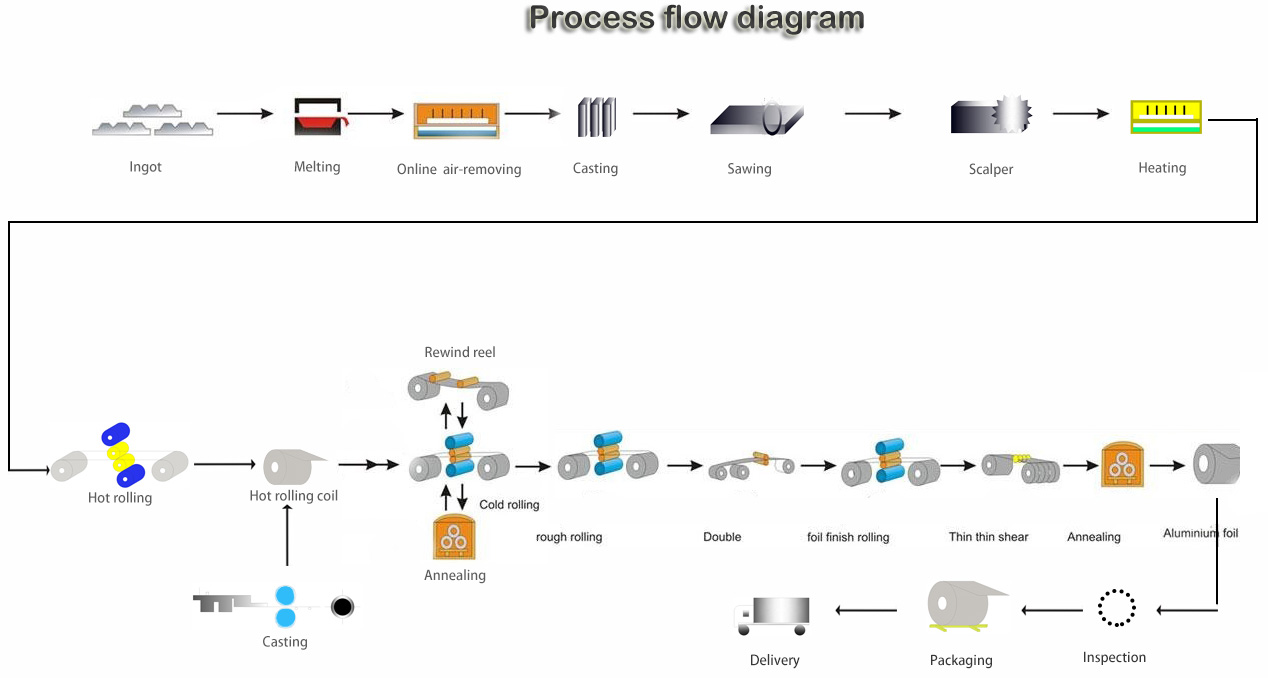
The exact mill route varies with alloy, starting stock and foil producer. A typical sequence can include casting or slab preparation, rolling, intermediate heat treatment, final foil rolling, cleaning or degreasing, annealing where required, slitting, inspection and packing.
Rolling reduces the aluminum to the required container-stock gauge while controlling thickness profile and surface condition.
Heat treatment is used where required to establish the specified material condition and forming characteristics.
Coils can be slit to the feed width required by the container press. Width tolerance, edge condition and winding quality are important for stable feeding.
Container stock may require a controlled lubricant or approved surface treatment to support forming and release from tooling. The lubricant and coating system must be appropriate for the intended food-contact application.
Plain mill-finish foil can be used where the forming process and food-contact conditions do not require an additional organic coating.
A controlled lubricant can reduce friction between the foil and tooling during container forming. Buyers should specify lubricant type, application level and any applicable food-contact requirements.
An approved internal coating or lacquer can be specified where the packaged food, contact time or processing conditions require separation between the food and bare aluminum.
Where a container will be sealed with a lid, the required sealing surface, lacquer, polymer layer, lid material, sealing temperature and peel or bond requirement should be specified as part of the complete package design.
Food-contact suitability should be evaluated for the actual aluminium alloy, lubricant, lacquer, ink, adhesive or polymer layer supplied. The statement that a material is aluminium does not by itself establish compliance for every food, temperature and destination market.
Acidic foods can increase interaction with uncoated aluminium. Products containing tomato, citrus, vinegar or other acidic ingredients may therefore require an appropriate coated container or application-specific migration assessment.
High salt content can also increase corrosion or aluminium migration under some conditions. Food composition, storage time and temperature should be considered before selecting a bare or coated container.
A short serving application and long-term refrigerated storage can impose different food-contact requirements even when the same food is involved.
Heating, baking, holding and freezing conditions should be included in the packaging specification. The suitability of coatings, lubricants and seals may be different from that of the aluminum substrate itself.
Buyers should identify the applicable food-contact regulation, migration requirement, declaration or test report required in the destination market before bulk production.
Aluminum provides an effective barrier to light and, where the material is intact, to gases and moisture vapor. In a finished container, overall package performance also depends on seams, lids, rim design, coatings and the method used to close the container.
The opaque metal body prevents light from passing directly through the container wall, which can be useful for light-sensitive packaged products.
The aluminum wall provides strong barrier performance, but the complete package cannot be assigned a shelf life from the foil alone. Lid material, sealing integrity, food processing and storage conditions also determine preservation performance.
A properly closed foil container can contribute to limiting external odor transfer, but the actual barrier of a packaged meal depends on the container-lid interface and sealing system.
Deep container geometries require sufficient ductility and well-controlled tooling. Draw ratio, blank size, corner radius, lubrication, press speed and hold-down force can all influence forming success.
Wrinkle-wall trays use controlled folds or corrugations to accommodate forming and increase rigidity. 8011 and other suitable container alloys can be evaluated according to tray geometry and tool design.
Smooth-wall designs place different demands on elongation, rigidity and rim formation. 8006 is commonly considered for this type of application where the actual material and tooling specification are compatible.
The rim may need to retain a board lid, foil lid or heat-sealed closure. Material hardness and tooling should support consistent flange geometry without excessive cracking or wrinkling.
Container foil can be formed into trays for restaurant takeaway, prepared meals and food-delivery applications where the selected container structure is suitable for the packaged food.
Airline and catering trays may require controlled gauge, rim dimensions, stacking behavior and compatibility with food preparation and reheating processes.
Aluminum containers can be produced for compatible baking and oven applications. The complete finished container, coating, food and heating conditions must be suitable for the intended temperature and use.
Formed foil containers can be used for suitable chilled and frozen-food applications when the closure system, coating and food-contact specification are compatible with the storage conditions.
Disposable and semi-rigid trays can be designed for household cooking, catering, buffet service and meal preparation according to the required capacity and container geometry.
Aluminum has a high melting temperature relative to ordinary food-heating conditions, but the permitted operating temperature of a finished container can be limited by coatings, inks, adhesives, lids, food composition and the specific container design.
A foil container should not automatically be considered suitable for direct flame or uncontrolled heating. Use conditions must follow the finished container manufacturer's instructions.
Microwave compatibility depends on the specific container geometry, appliance design and operating instructions. Buyers should not assume that every aluminum foil container is suitable for every microwave oven.
Where alloy and temper are contractual, they should be identified in the purchase specification and confirmed through the applicable material documentation.
Gauge and width should be controlled according to the press, die and blank requirements. Excessive variation can affect container weight, forming behavior and finished rigidity.
Where tensile strength or elongation is important to forming performance, specify the applicable range for the actual alloy, temper and gauge rather than applying one value to all container foil.
Container foil should be controlled for unacceptable oil contamination, corrosion, stains, scratches, roll marks and foreign material that could interfere with forming or food-contact performance.
For pre-lubricated stock, lubricant quantity and uniformity should be matched to the forming process and applicable food-contact requirement.
Where lacquer or resin coating is supplied, coating thickness, adhesion, curing and migration requirements should be specified for the finished food-contact application.
Clean slit edges and stable coil winding help prevent feed problems on high-speed container presses. Buyers should provide applicable edge, coil OD and winding requirements.
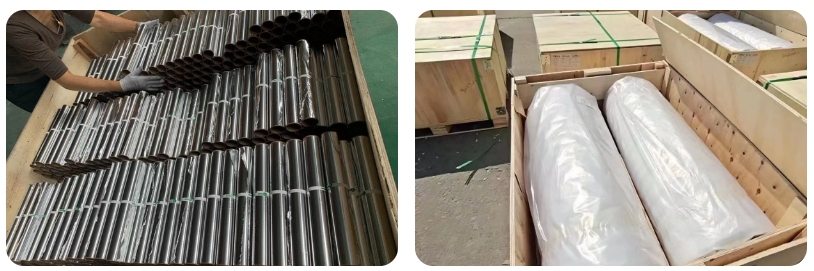
Food-container foil coils should be protected against moisture, impact, edge damage and movement during transportation. Packing should be selected according to coil dimensions, orientation, pallet loading and the customer's unloading method.
Storage areas should be clean and dry. Condensation should be avoided because moisture trapped between foil layers or packaging materials can affect the surface condition.
Aluminum is recyclable, but the actual recyclability of a used food container depends on contamination, coatings, attached lids or other materials and the collection and recycling infrastructure available in the destination market.
Broad environmental claims should therefore be based on the finished packaging design and local recovery system rather than the aluminum material alone.
Specify 8011, 8006, 3003, 3004 or another required alloy together with O, H22, H24 or the applicable temper.
Provide the exact nominal gauge and tolerance required by the container press and finished-product specification.
Specify the slit width required by the blanking or container-forming line.
Provide finished length, width, depth, corner radii, flange geometry, rib pattern and any smooth-wall or wrinkle-wall requirement.
Provide press type, forming depth and any known mechanical-property requirement where severe forming is involved.
State whether dry or pre-lubricated foil is required and provide any applicable lubricant specification.
Identify the intended food type, particularly acidic or salty food, together with storage time, heating conditions and whether direct food contact is required.
If an internal or external coating is required, provide coating type, color, curing, migration and application requirements.
Specify the destination market and any required declaration, migration test, material certificate or customer-specific food-contact documentation.
Provide coil ID, maximum OD, preferred coil weight, winding direction, pallet orientation, quantity and destination.
Send Your Food Container Foil Requirements
8011, 8006 and 3003 are widely used container-foil alloys, while 3004 can also be selected for compatible applications. Final choice depends on forming depth, rigidity, container geometry and tooling.
8011 is widely used for conventional container and household foil. 8006 can be considered where the container requires a different balance of strength, elongation, rigidity and forming behavior, including compatible smooth-wall applications.
3003 can be useful where greater material strength is required while retaining useful forming performance. The correct temper and gauge should be selected from the actual container design.
O temper is softer and generally provides greater forming allowance. H22 and H24 provide progressively different strength and hardness characteristics. Selection depends on forming depth and required finished rigidity.
Commercial container foil is commonly supplied across a range of approximately 0.03-0.20mm, but the correct gauge depends on alloy, temper, container dimensions, forming depth and required rigidity.
No. Container foil is selected for press forming into semi-rigid trays and is generally specified by alloy, temper, gauge, lubrication and mechanical forming requirements. Household foil is optimized for wrapping rather than container stamping.
No. Food composition, acidity, salt content, contact time and temperature can affect interaction with uncoated aluminum. Some applications may require a suitable food-contact coating or liner.
Long or hot contact between acidic foods and uncoated aluminum can increase metal migration. For products such as tomato-based, citrus or vinegar-containing foods, the appropriate coated container or tested packaging construction should be selected.
Salt can increase interaction with bare aluminum under some conditions. Food formulation, contact time and temperature should be evaluated before selecting the container surface.
No fixed shelf-life extension should be attributed to the aluminum alone. Shelf life depends on the food formulation, processing, hygiene, lid and seal integrity, storage temperature and complete packaging system.
Compatible finished aluminum containers can be used for baking applications when the container construction, surface treatment, food and specified heating conditions are suitable.
Do not assume universal microwave compatibility. Suitability depends on the container design and microwave appliance instructions. The finished container manufacturer should provide the applicable use guidance.
Lubrication reduces friction during stamping and drawing, helping material flow through the die. The lubricant type and quantity should be compatible with both the forming process and food-contact requirements.
A coated or lacquered construction can be discussed where required. Buyers should specify food type, temperature, migration requirements, coating side, color and any heat-sealing requirement.
Food-contact suitability must be established for the actual alloy, lubricant, coating and intended conditions of use. Buyers should specify the applicable destination-market requirements and required documentation.
Aluminum is recyclable. Whether a used food container is actually recovered depends on food contamination, attached materials and the local recycling system.
The foil can be supplied for forming different container sizes, but the finished dimensions are determined by the customer's tooling. Provide the container drawing so alloy, temper and gauge can be evaluated against the geometry.
Please provide alloy, temper, thickness, width, container drawing, forming depth, lubrication requirement, bare or coated surface, food type, heating or storage conditions, coil ID, coil OD, quantity, food-contact documentation requirement and destination.
If you manufacture takeaway trays, airline meal containers, bakery pans or other formed aluminum food packaging, send us your container drawing, alloy, temper, gauge, coil dimensions and food-contact requirements for technical confirmation and quotation.
Food container aluminum foil, often simply referred to as aluminum foil, is a thin, versatile sheet made from aluminum metal. It is commonly used for packaging and preserving food.
Production Process of Food Container Aluminium Foil
The food container aluminum foil manufacturing process generally goes through casting, homogenization, surface treatment, hot rolling, cold rolling, foil rolling, washing, winding, annealing, and finally cutting.
The Food Container Aluminum Foil Structure
Aluminum is a very active metal, so it is easily oxidized by oxygen in the air to form aluminum oxide at normal temperature and pressure. Aluminum oxide is a dense protective film, which can prevent some substances from further corroding aluminum.
Specification of food container aluminium foil
Food container aluminium foil,also called dinner ware, which is mainly used for making fast food tray for airline or household food package case.The main alloy for making it include 8011,8006,3003,3004 etc,and most of which are at "O”,H22 and H24 temper.
Aadvantage of food container aluminium foil
1.Heat Resistance: Aluminum foil can withstand high temperatures without melting or deforming, making it suitable for baking, grilling, and reheating food.
2.Barrier Properties: Aluminum foil acts as an effective barrier against moisture, light, oxygen, and other contaminants. This helps keep food fresh and prevents it from spoiling quickly.
3.Insulation: Aluminum foil reflects heat, helping to keep food warm or cold as needed. It is often used in insulated bags and containers to maintain temperature.
4.Non-Toxic: Aluminum foil is safe for food contact and does not transfer any harmful chemicals or flavors to the food.
5.Easy to Shape: Aluminum foil is pliable and can be easily molded to wrap around different shapes and sizes of food items.
6.Recyclable: Aluminum foil is recyclable, making it an environmentally friendly choice for packaging.
7.Versatility: It can be used for wrapping sandwiches, covering baking dishes, lining grill grates, and more.
8.Hygiene: Aluminum foil is a hygienic option for food storage as it can be easily wiped clean and does not absorb food odors.
9.Portability: Aluminum foil containers are lightweight and portable, making them suitable for takeout and leftovers.
10.Customizable: Manufacturers can produce aluminum foil containers in various sizes and shapes to suit specific food packaging needs.
11.Cost-Effective: Aluminum foil is an affordable option for food packaging, making it a popular choice for both commercial and household use.
12.Long Shelf Life: Food stored in aluminum foil containers tends to have a longer shelf life due to the protective barrier it provides.
Packaging and Transportation of Food Container Aluminium Foil
The packaging of food container aluminium foil should be based on the specification and size of the product. The packaging box and packaging method should be selected. For box-type packaging, the product should not be squeezed or moved after the box.
FAQ of Aluminium Foil
Q: What is the difference between Aluminum Foil and Tin Foil?
A:Aluminum is often confused with tin, such as tin foil etc. Aluminum has replaced tin in most industrial applications, such as cans. Tin is considered to be toxic to humans whereas specific aluminum alloys have been FDA approved for direct and indirect food contact.
Q:Is Food Grade Aluminum Foil Toxic?
A:It's incredibly unlikely that you'll consume toxic amounts of aluminum just by cooking with foil.
Q:Are Aluminium Foils’ products environmentally friendly?
A:Yes. Materials purchased from Aluminium Foils are compliant to regulations defined in RoHS II, SVHC, REACH and Conflict Minerals.
Q:How long can you keep food in aluminum foil?
A:Three to four days
Q:Is aluminum foil recyclable?
A:Aluminum foil is recyclable if it's free of food residue. Do not recycle dirty aluminum because food contaminates recycling.
Products
Application
Quick links
Contact Us