8011 O
DINGANG
7607110000
| Availability: | |
|---|---|
| Quantity: | |
8011 beer label aluminium foil is soft, ultra-thin aluminum foil supplied for the production of printed, lacquered, embossed and die-cut labels used around the neck or upper body of beer, beverage and compatible glass bottles.
For this product, AA8011 in O temper is the primary specification. Typical beer-label foil thickness is approximately 0.010-0.0115mm, or 10-11.5μm, while a typical width range for the listed beer-label application is approximately 300-500mm. Wider master rolls or custom slit widths can be discussed according to the converter's printing, embossing and die-cutting equipment.
The aluminum foil itself is normally supplied as converting stock. Printing, colored lacquer, embossing, perforation, die cutting and final label shaping can be specified separately depending on whether the buyer requires raw foil or a finished bottle-neck label construction.
Beer neck foil should be selected primarily for appearance, printability, folding behavior, embossing performance and compatibility with high-speed label conversion and bottle-labeling equipment. It should not be treated as the primary closure responsible for sealing the beer inside the bottle.
Request 8011 Beer Label Foil Pricing
| Parameter | Specification / Ordering Requirement |
|---|---|
| Product | Beer Label Aluminium Foil / Beer Bottle Neck Label Foil |
| Primary Alloy | AA8011 |
| Temper | O / soft temper |
| Typical Thickness | 0.010-0.0115mm / 10-11.5μm for typical beer bottle neck-label applications |
| Custom Thickness | Other thin-foil gauges can be discussed according to converting and label requirements |
| Typical Application Width | Approximately 300-500mm; custom master-roll or slit widths subject to production and converting requirements |
| Thickness Tolerance | To be agreed for the ordered micron gauge according to the applicable foil specification or customer requirement |
| Surface | Bright / dull rolling surface or other agreed finish according to printing and converting requirements |
| Printing | Suitable surface preparation can be specified for compatible gravure, offset or other label-printing processes |
| Lacquering | Primer, colored lacquer or protective coating subject to the required finished-label construction |
| Embossing | Available at the converting stage according to pattern, depth and foil performance requirements |
| Die Cutting | Finished labels can be converted to the required neck-label or body-label shape |
| Reel Dimensions | Core ID, coil OD, roll weight and unwind direction to be confirmed according to printing, embossing or labeling equipment |
| Applicable Standard | Applicable aluminum-foil standard or customer specification can be agreed for bare foil; converted printed, coated or embossed labels require finished-product acceptance criteria |
| Application | Beer bottle neck labels, upper-body bottle labels and compatible beverage-bottle decorative labels |
| Export Packing | Waterproof protective material, steel strapping and seaworthy export packing according to reel configuration |
For quotation, provide required thickness, foil width, bare foil or finished-label construction, printing requirement, lacquer system, embossing pattern, reel dimensions, unwind direction, surface requirement, quantity and destination.
Send Your Beer Label Foil Specification
Beer label aluminium foil is very thin aluminum foil used as the metallic substrate for decorative labels applied to glass beverage bottles. Typical locations include the neck, shoulder or upper body of the bottle.
The foil can be printed with brand graphics, coated with colored lacquer, embossed with decorative patterns and die cut into the required shape. Soft foil conforms closely to the curved bottle surface and can produce the traditional metallic appearance associated with many beer and beverage packages.
Raw beer label foil is supplied in rolls for further conversion. The converter may subsequently apply primer, ink, lacquer, embossing, perforation and die cutting according to the beverage brand and labeling line.
A finished neck label includes additional converting operations beyond the aluminum foil itself. Buyers requiring finished labels should provide artwork, dimensions, print colors, embossing pattern, lacquer requirement and bottle-application conditions.
O-temper foil provides a soft material condition that allows the converted label to conform around curved bottle necks and shoulders with limited springback.
Beer label foil must remain thin and flexible while maintaining sufficient handling strength during printing, embossing, die cutting and label application. Actual mechanical-property requirements should therefore be defined for the ordered gauge rather than inferred from the alloy designation alone.
Soft aluminum foil can reproduce fine embossed patterns when the foil gauge, embossing tooling and converted construction are properly matched. Embossing can create texture, branding details and a distinctive premium appearance.
The foil surface can be prepared for compatible primers, inks and decorative lacquers. Surface cleanliness and wettability should be specified where they directly affect print or coating adhesion.
Beer bottle neck-label foil is commonly produced at approximately 10-11.5μm. This thin gauge allows the label to remain flexible and conformable while minimizing material use.
Approximately 0.010mm foil can be considered where a lightweight, flexible label structure is required and the printing, embossing and application process is compatible with the thinner gauge.
Slightly heavier gauges can provide different handling and mechanical characteristics during converting and label application. Selection should follow the actual printing and labeling equipment rather than thickness alone.
For foil only about 0.010-0.0115mm thick, dimensional tolerance must be appropriate to the micron-level product. A generic ±0.01mm sheet-metal tolerance is not suitable for specifying this thin foil.
Buyers should state the applicable foil standard or agreed percentage or micron tolerance when thickness variation is contractual.
A typical width range for beer-label foil is approximately 300-500mm, while converters may purchase wider master rolls and slit them according to printing or label-converting requirements.
Core ID should match the customer's unwinding, printing, embossing or slitting equipment. It should be stated with the purchase order rather than assumed from foil width.
Converters should specify the maximum coil OD and roll weight accepted by the unwind stand. Oversized reels can create handling or machine-loading problems even when width and gauge are correct.
When one foil side requires printing, primer or another surface treatment, unwind orientation should be confirmed so the correct surface enters the converting line.
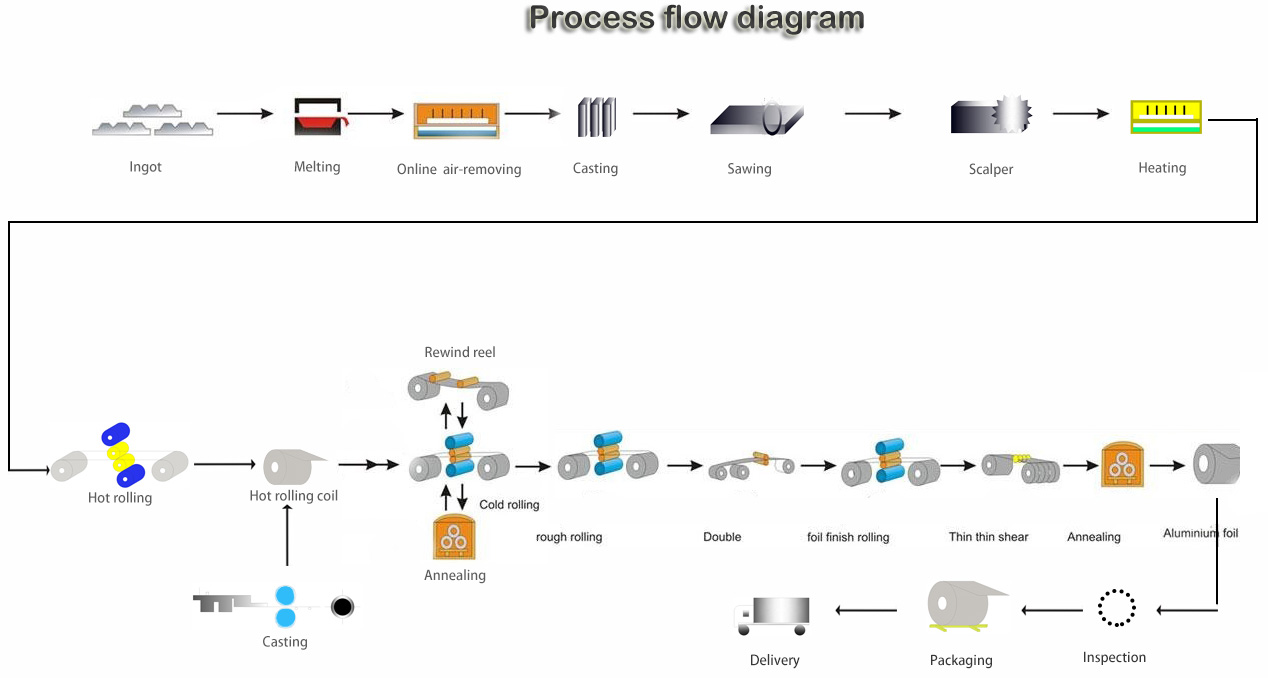
The exact mill route depends on the producer and starting material. A typical manufacturing route for thin AA8011 foil can include casting or stock preparation, rolling, intermediate heat treatment, foil rolling, cleaning, annealing, slitting, inspection and packing.
The 8011 alloy is prepared and rolled through the required reduction stages before final foil rolling.
Rolling reduces the material to the required thin gauge while controlling thickness profile and surface condition.
Where O temper is required, annealing establishes the soft final condition. Control of rolling lubricant and surface cleanliness is important for foil that will subsequently receive primer, ink or lacquer.
The finished foil can be slit and rewound to the width, core and coil configuration required by the converter.
Finished rolls can be checked for dimensions, surface defects, edge condition and winding quality before protective export packing.
Aluminum naturally forms a thin oxide film when exposed to air. This natural surface contributes to the corrosion resistance of aluminum but should not be confused with an anodized coating or the lacquer and primer systems used during label conversion.
For beer-label foil, printing and coating performance depend primarily on the actual foil surface condition, cleanliness, rolling oil residue and any applied pretreatment or primer. These factors should be controlled according to the converter's process.
Printing quality depends on the complete combination of foil surface, primer, ink system, printing method and curing conditions. Buyers ordering raw foil for their own printing process should state the required surface treatment or wettability.
Colored lacquer can provide gold, red, green, blue or other metallic-effect backgrounds while retaining the character of the aluminum substrate. The lacquer chemistry, coating weight, curing and print compatibility should be specified for the finished label.
A primer can be used to improve adhesion between the aluminum and subsequent printing or coating layers. The required system should be confirmed according to the converter's ink and lacquer process.
Where the finished label must match a brewery's corporate color, an approved physical sample or numerical color tolerance should be used. Metallic foil appearance can influence perceived color compared with printing on paper.
Embossing is widely used with beer bottle neck labels to create texture and reinforce brand identity. Patterns can include fine geometric textures, logos or other decorative designs.
A repeating embossed pattern can be applied across the label where a consistent textured appearance is required.
Localized embossing can emphasize logos or selected graphic elements. Tooling, registration and foil deformation should be considered together with the printed artwork.
Excessive embossing depth can increase strain on ultra-thin foil. Representative converting trials should be used where deep or sharply defined patterns are required.
Producing raw aluminum foil and manufacturing the final printed beer label are separate stages. A typical downstream label-converting process can include the following operations.
A suitable primer or colored base coat can be applied where required by the printing construction.
Brand names, logos, graphics, product information and decorative colors can be printed using a compatible label-printing process.
The printed foil can be embossed to create the required texture or branding effect.
Some label constructions or application systems may specify controlled perforation. Hole pattern and density should be defined by the converter or bottling-line requirement rather than assumed for every beer label.
The converted material can be cut into the final neck-label shape according to bottle geometry and brand artwork.
Finished labels are applied to the bottle using compatible adhesive and labeling equipment. Label dimensions, flexibility and surface construction should match the bottling line.
The primary application is a decorative foil label wrapped around the neck or shoulder of a glass beer bottle.
Suitable foil constructions can also be converted into decorative metallic labels for selected areas of the bottle body.
Similar soft foil can be evaluated for compatible beverage or wine-bottle decorative labels where gauge, coating and application requirements are appropriate.
The metallic surface, printing and embossing can create a distinctive appearance that supports brand recognition and premium bottle presentation.
A neck label provides decorative coverage around the exterior bottle neck and can conceal portions of the glass or closure area according to the package design.
The decorative neck label should not be treated as the main barrier that seals beer inside the bottle. Product retention, gas containment and closure integrity are functions of the bottle and closure system.
The presence of an aluminum neck label alone does not establish or extend a defined beer shelf life. Shelf life depends on beverage formulation, filling process, bottle, closure, light exposure, storage and distribution conditions.
Stable foil gauge supports consistent printing, embossing, die cutting and bottle application. Thickness tolerance should be appropriate to the 10-11.5μm product range.
The foil should be free from unacceptable oil contamination, corrosion, stains and other surface defects that interfere with primer, lacquer or printing adhesion.
Where ink, lacquer or adhesive will be applied directly to the foil, the converter should specify the required surface wettability and applicable test method.
Pinhole acceptance can be specified where appearance or converting performance requires control. Naturally occurring foil pinholes should be distinguished from deliberate perforation added during label conversion.
Excessive burr, edge cracks or uneven slitting can affect printing and reel handling. Edge condition should be agreed for high-speed converting lines.
Finished coils should be wound without unacceptable telescoping, loose winding, wrinkles or edge deformation that could disturb continuous printing or embossing.
If tensile strength and elongation are contractual, they should be specified for AA8011-O at the actual ordered thickness using the applicable foil standard or agreed customer specification.
High-speed label production depends on more than alloy and thickness. Stable reel geometry and surface consistency can reduce interruptions during printing, lacquering, embossing and die cutting.
The coil should unwind smoothly without excessive telescoping, edge damage or tension variation.
Variation in oil residue or surface condition can change ink or lacquer wetting behavior. Converters should define relevant cleanliness and wettability requirements.
Consistent thickness and temper help maintain repeatable embossed detail during long production runs.
Material properties, coating construction and die setup should allow the required label shape to be cut without unacceptable tearing or edge deformation.
The aluminum substrate provides a natural metallic appearance that can remain visible through transparent or specially formulated decorative coatings.
Gold, red, green, blue and other visual effects can be created through appropriate lacquer and printing systems. Exact color and metallic appearance should be approved using a representative sample.
Finished labels can incorporate logos, typography and graphic elements according to the buyer's artwork and printing capability.
A standard bottle-neck label is normally applied to the outside of the bottle rather than used as the primary material in direct contact with the beverage.
If a particular label, lacquer, adhesive or foil component will contact a closure area subject to food-contact requirements, the buyer should specify the applicable destination-market regulation and required documentation for the actual finished construction.
Food-contact or chemical-compliance claims should not be inferred solely from the AA8011 alloy designation because printing inks, lacquers, primers and adhesives form part of the final label construction.
Aluminum is a recyclable metal. The actual recovery of a used beer neck label depends on whether it is separated from the bottle, the amount of lacquer, ink and adhesive present, and the collection and recycling system available in the destination market.
For packaging sustainability programs, recyclability should therefore be assessed using the complete label-and-bottle packaging system rather than the aluminum foil substrate alone.
Ultra-thin beer label foil should be protected against moisture, impact, edge damage and coil deformation during storage and transportation.
Export packing can use waterproof protective material, suitable inner protection, steel strapping and seaworthy outer packing according to coil diameter, width and shipping method.
State whether you require bare AA8011-O foil for your own converting line or a printed, lacquered, embossed or die-cut bottle-neck label.
Specify the required nominal thickness, such as 0.010mm, 0.0105mm, 0.011mm or 0.0115mm, together with the required tolerance.
Provide master-roll or slit width according to your printing and converting equipment.
Specify bright or dull side orientation, surface cleanliness, wettability or any primer requirement needed for printing or coating.
For finished labels, provide artwork, print colors, lacquer color, print side and approved visual reference.
Provide the required embossing pattern, artwork or physical sample and identify any registration requirement between embossing and print.
For finished labels, provide the die-cut dimensions and bottle-neck geometry or an existing approved label sample.
Provide core ID, maximum coil OD, coil weight and unwind direction for raw foil supplied to a continuous converting line.
State any contractual thickness tolerance, tensile strength, elongation, wettability, pinhole, edge quality, printing or embossing acceptance requirement.
Provide order quantity for each specification, packing requirements and destination so coil and export-packing arrangements can be confirmed.
Send Your Label Artwork & Foil Requirements
AA8011 in O temper is widely used for beer bottle neck-label foil. Other soft foil alloys such as 1235 or 8079 can also be used for compatible label constructions.
A typical beer neck-label foil thickness is approximately 0.010-0.0115mm, equivalent to 10-11.5μm.
O temper provides a soft and flexible condition that can conform to curved bottle surfaces and support embossing, die cutting and other label-converting operations.
No. 8011 is a common choice, while 1235 and 8079 are also used in some soft thin-foil label applications. Final alloy selection should follow gauge, mechanical and converting requirements.
Yes. The foil can be converted using compatible primers, inks and printing systems. Surface cleanliness and wettability should match the chosen printing process.
Yes. Soft beer-label foil is suitable for compatible embossed patterns. Embossing depth, tooling and label construction should be evaluated together.
Gold and other colored metallic appearances can be produced using suitable lacquer and printing systems. Final appearance should be approved using a physical sample.
Custom logos and graphics can be incorporated into finished labels according to artwork, printing capability, color requirements and label dimensions.
Finished foil labels can be die cut according to the required bottle-neck shape. Provide a drawing, artwork or approved sample when requesting a converted label.
A decorative beer neck label should not be treated as the primary bottle seal. The bottle closure is responsible for containing the beverage and maintaining closure integrity.
No fixed shelf-life extension should be attributed to the decorative neck foil alone. Beer shelf life depends on formulation, filling, bottle color, closure, light exposure and storage conditions.
No. A tolerance equal to the nominal foil thickness is not appropriate for this product. Beer-label foil requires a micron-level or percentage tolerance suitable for the ordered gauge and applicable foil specification.
Approximately 300-500mm is a typical application range for beer-label foil, although wider master coils and custom slit widths can be supplied according to converter capability.
Residual rolling oil, stains or contamination can interfere with primer, ink and lacquer adhesion. Surface cleanliness is therefore important for stable label conversion.
Controlled wettability helps primers, inks, lacquers and adhesives spread uniformly over the aluminum surface. The required level should be specified according to the converter's process.
The applicable parts of EN 546 can be used as a reference for bare rolled aluminum foil where agreed. Printed, lacquered, embossed or otherwise converted labels should also have separate finished-product acceptance requirements.
Aluminum itself is recyclable. Actual recovery of a used neck label depends on separation from the bottle, inks, lacquer, adhesive and local recycling infrastructure.
Please provide foil thickness, width, AA8011-O requirement, bare foil or finished-label construction, surface requirement, printing colors, lacquer, embossing, label dimensions, core ID, coil OD, unwind direction, quality requirements, quantity, packing and destination.
If you are sourcing AA8011-O aluminum foil for beer bottle neck labels, printed beverage labels or downstream embossing and die cutting, send us your gauge, width, surface requirement, reel dimensions, label artwork and converting specifications for technical confirmation and quotation.
Beer label aluminum foil is aluminum foil for labeling bottled beer.
Its printed shape is exquisite and fashionable, and it is widely used in beer canning industry.
The thickness of beer label aluminum foil is usually 0.010-0.0115mm, and the width specification is between 300-500mm, which belongs to the category of single zero foil. The alloy composition, casting process and heat treatment process all have an important influence on the mechanical properties of the single-zero foil final product. Therefore, the 8××× alloy series with certain strength and elongation and excellent formability is the first choice. 8011 alloy is generally used for the production of aluminum foil materials such as air-conditioning foil fins, medical bottle caps, anti-theft caps for non-pressure beverages and foreign wine, and wine bottle caps, with good formability.
Production Process of 8011 Beer label Aluminium Foil
The 8011 beer label aluminum foil manufacturing process generally goes through casting, homogenization, surface treatment, hot rolling, cold rolling, foil rolling, washing, winding, annealing, and finally cutting.
8011 Beer label Aluminum Foil Structure
Aluminum is a very active metal, so it is easily oxidized by oxygen in the air to form aluminum oxide at normal temperature and pressure. Aluminum oxide is a dense protective film, which can prevent some substances from further corroding aluminum.
Specification of 8011 Beer label Aluminum Foil
| Product Name | Beer label Aluminum Foil |
| | 8011 O |
| Thickness | 0.2mm-300mm or as required |
| Width | 3mm-2000mm or as required |
| Length | 2000mm,2440mm,6000mm,or as required. |
| Standard | AISI,ASTM,DIN,JIS,GB,JIS,SUS,EN,etc. |
| Technique | Hot rolled/Cold rolled |
| Thickness tolerance | ±0.01mm |
| | Food Packaging Foil, Single Zero Foil, Battery Foil, Electronic Foil, Aluminum Tape, Medicinal Foil, Air Conditioner Foil, Heat Seal Foil, etc |
| Export Packing | Waterproof paper,and steel strip packed.Standard Export Seaworthy Package. |
Aadvantage of 8011 Beer label Aluminium Foil
High Visual Appeal: Beer label aluminum foil can be easily designed and printed with a range of colors, logos, and graphics that enhance the visual appeal of the beer bottle. The foil's metallic luster can also add a luxurious touch to the overall packaging.
2.Durability and Shelf Life: Beer label aluminum foil is highly durable and can withstand various environmental conditions, such as moisture, light, and oxygen exposure, for extended periods. This ensures that the label remains readable, intact, and attractive over time, maintaining the freshness and value of the beer.
3.Protection of Content: Beer label aluminum foil effectively seals and protects the beer from external factors that may affect its quality and taste. The foil's barrier properties prevent moisture, light, and oxygen from penetrating the bottle, maintaining the integrity and flavor of the beer.
4.Safety and Hygiene: Beer label aluminum foil is non-toxic and inert, ensuring that it does not contain any harmful substances that could leach into the beer or come into contact with the consumer. The use of aluminum foil also complies with food packaging regulations and hygiene standards, providing peace of mind to consumers.
5.Recyclability: Beer label aluminum foil is 100% recyclable, as it can be easily separated from the bottle and processed for reuse at the end of its useful life. Recycling aluminum reduces waste and saves natural resources, making it environmentally friendly.
6.Flexibility and Adaptability: Beer label aluminum foil is highly flexible and can be easily cut, shaped, and molded to fit different bottle shapes and sizes. This provides designers with the freedom to create unique and custom-designed labels that fit specific beer brands and styles.
7..Cost-Effective: Although aluminum is a relatively expensive material compared to some other packaging materials, beer label aluminum foil is cost-effective due to its durability and longevity. The initial investment in aluminum foil packaging pays off in the long run by extending the shelf life .
Products
Application
Quick links
Contact Us