8011 O
DINGANG
7607110000
| Availability: | |
|---|---|
| Quantity: | |
Aluminum foil is thin flat-rolled aluminum supplied in jumbo rolls, slit rolls and application-specific converted formats for food packaging, household foil, semi-rigid containers, pharmaceutical packaging, flexible laminates, lidding, HVAC, insulation and industrial converting.
Commercial aluminum foil is generally produced at thicknesses up to 0.20 mm, with very thin flexible-packaging foil extending down to approximately 0.006 mm for suitable alloys and processes. Exact production capability depends on alloy, temper, width, surface condition and the intended converting process.
Common foil alloys include 1235, 3003, 5052, 8006, 8011, 8021 and 8079, but they are not interchangeable. Household foil, container stock, pharmaceutical foil, flexible laminates and technical foil each require different combinations of strength, elongation, pinhole control, surface cleanliness, coating compatibility and forming performance.
For an accurate quotation, specify the finished application first, followed by alloy, temper, nominal gauge, width, roll dimensions, surface, coating or lamination requirements and the downstream process.
Different foil applications require different alloy, temper and surface specifications. The following ranges are practical selection references; final production availability and tolerances should be confirmed for the exact order.
| Application | Common Alloy Options | Typical Temper | Typical Gauge Reference | Main Purchasing Focus |
|---|---|---|---|---|
| Household Foil | 8011 / 1235 | O | Approximately 0.008–0.040 mm | Softness, rewinding, clean surface, roll quality and food-contact requirements |
| Food Container Foil | 3003 / 3004 / 8006 / 8011 | O / H22 / H24 | Approximately 0.030–0.200 mm | Drawability, rigidity, elongation, earing, forming stability and surface cleanliness |
| Flexible Packaging Foil | 1235 / 8011 / 8079 | O or application-specific condition | Approximately 0.006–0.030 mm | Pinhole control, cleanliness, lamination adhesion, wettability and roll quality |
| Pharmaceutical Foil | 8011 / 8021 / 8079 | O / H18 according to package structure | Application-specific thin foil | Pinhole control, cleanliness, coating, printability, forming and regulated packaging requirements |
| Lidding / Heat-Seal Foil | 8011 / 8079 or specified alloy | O / H-series according to conversion | Application-specific | Heat-seal lacquer, seal strength, printability, coating adhesion and burst performance |
| HVAC / Fin Stock | 1100 / 3003 / 3102 / 8011 or specified alloy | O / H22 / H24 / application-specific | Typically medium-gauge foil | Fin forming, hydrophilic coating, corrosion resistance and heat-exchanger requirements |
| Technical / Industrial Foil | 1050 / 1060 / 1100 / 1235 / 3003 / 5052 / 8011 or specified grade | O / H-series according to application | Application-specific | Strength, conductivity, corrosion resistance, bonding, coating and converting method |
| Battery-Related Foil | Dedicated grade according to battery design | Application-specific | Precision thin gauge | Electrical properties, surface cleanliness, strength, thickness uniformity and cell-manufacturer specification |
Battery current-collector foil, pharmaceutical foil and other controlled technical products should always be purchased against the exact end-use specification. A general packaging foil should not be substituted solely because the nominal alloy or thickness appears similar.
Ask Which Aluminum Foil Grade Fits Your Application
| Product | Aluminum foil jumbo roll / slit foil roll / application-specific foil stock |
| Common Alloy Families | 1xxx, 3xxx, 5xxx and 8xxx series depending on application; common foil grades include 1235, 3003, 5052, 8006, 8011, 8021 and 8079 |
| Temper | O / H14 / H16 / H18 / H19 / H22 / H24 and other applicable conditions depending on alloy and end use |
| Foil Thickness | Typically approximately 0.006–0.200 mm across commercial foil categories; exact range depends on alloy, temper, width and application |
| Products Above 0.20 mm | Normally specified as thin strip or sheet rather than conventional foil |
| Width | The existing production information references widths from 3 to 2000 mm; final capability depends on foil gauge, alloy, temper, slitting and roll configuration |
| Length | Foil is primarily supplied by coil or roll length/weight rather than standard sheet lengths; cut formats can be discussed where required |
| Surface | One-side bright / matte, two-side bright, mill finish, degreased, lubricated, coated, lacquered, laminated, embossed or printed according to application |
| Technique | Cold rolling and foil rolling with annealing or strain-hardening according to the required temper |
| Thickness Tolerance | Gauge-specific tolerance according to nominal thickness, alloy, width and applicable purchase specification |
| Relevant Standards | EN 546 series, ASTM B479, GB/T 3198 or other mutually agreed foil and customer specifications where applicable |
| Supply Form | Jumbo roll, slit roll, rewinding stock or customized converted format |
| Export Packing | Water-resistant wrapping, protective strapping and seaworthy export pallet or case according to roll size and shipping requirements |
1235 is a high-aluminum-content foil grade commonly considered for flexible packaging, lamination, household and other thin-foil converting applications where softness and thin-gauge rolling are important.
3003 is an Al-Mn alloy with greater strength than commercially pure aluminum. It is widely evaluated for semi-rigid food containers, trays, honeycomb core and selected industrial forming applications.
5052 is an Al-Mg alloy selected for applications requiring higher strength and corrosion resistance. It is more application-specific than common household or flexible-packaging foil and should be ordered against the required temper and forming conditions.
8006 can be evaluated for semi-rigid container and formed packaging applications where its mechanical properties and forming behavior match the required tray design.
8011 is one of the most widely used foil alloys and can be specified for household foil, flexible packaging, lidding, pharmaceutical packaging, containers and selected technical uses. Temper and surface requirements vary substantially between these applications.
8021 is commonly associated with high-barrier packaging and applications requiring good ductility and controlled pinhole performance, including selected pharmaceutical and laminated packaging structures.
8079 is commonly used for thin flexible packaging and other applications requiring good elongation and thin-gauge rolling performance. Final suitability depends on temper, thickness, pinhole requirements and converting process.
| Temper | General Purchasing Consideration |
| O Temper | Fully annealed and soft; selected where ductility, deep forming, flexible packaging or easy rewinding is important |
| H18 / H19 | Hard conditions used where higher strength, stiffness or application-specific converting performance is required |
| H22 | Partially strain-hardened and partially annealed condition offering a balance between formability and rigidity for suitable formed products |
| H24 | Higher-strength partially annealed condition often evaluated for container and fin-stock applications where greater stiffness is required |
Temper should never be selected independently of alloy, gauge and converting process. A material that performs well during rewinding may not have the required rigidity for container forming, while a hard foil may not have sufficient elongation for deep drawing.
Correct thickness terminology helps prevent quotation and production errors. Conventional aluminum foil is generally supplied at thicknesses up to 0.20 mm. Products substantially thicker than this should normally be specified as aluminum strip, sheet or plate.
Foil around 0.10–0.20 mm is commonly associated with heavier formed or technical applications such as selected container stock and fin materials.
Single-zero foil is common industry terminology for thinner foil with one zero after the decimal point in millimetres. The exact meaning should be replaced by a numerical gauge in purchase orders.
Double-zero foil describes very thin gauges with two zeros after the decimal point in millimetres. These products require tighter control of pinholes, thickness uniformity, winding and surface quality.
Very thin foil may be double-rolled during the final reduction, producing one bright side and one matte side. The required orientation should be specified where appearance or downstream processing makes it important.
Two-side bright foil is used for suitable thicker gauges and applications where both exposed surfaces require a similar metallic appearance.
Clean surface condition is important for printing, lacquering, lamination, adhesive bonding and regulated packaging. Where adhesion is critical, specify wettability or surface-energy requirements rather than requesting only a visually clean surface.
Lacquers and coatings can provide heat sealing, corrosion protection, printing compatibility, decorative color or application-specific surface performance. Coating chemistry, side, dry-film thickness, adhesion and downstream forming requirements should be stated in the order.
Aluminum foil can be laminated with paper, PET, PE, CPP or other compatible materials to create flexible packaging and technical composite structures. Performance depends on the complete laminate, adhesive and sealing system.
Embossing and printing can be added for decorative, identification or packaging purposes where the selected foil temper and surface are compatible with the converting process.
Discuss Foil Surface and Coating Options
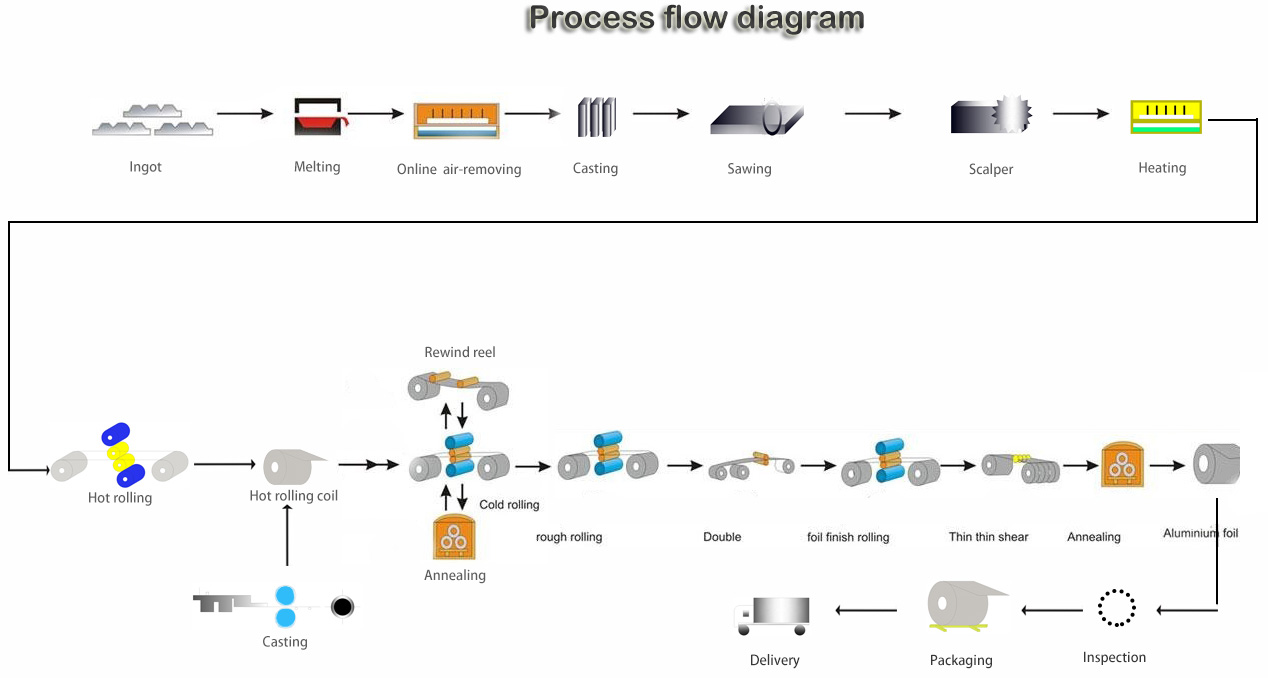
Aluminum foil production generally includes alloy preparation, casting, homogenization where required, hot or cold reduction, intermediate annealing, foil rolling, cleaning, final temper control, slitting, inspection and winding.
The exact production route depends on alloy, final thickness, temper and application. Flexible packaging emphasizes thin-gauge rolling and pinhole control, while container foil requires stable mechanical properties and forming performance.

Aluminum naturally develops a thin oxide film when exposed to air. This passive layer provides useful protection against continued atmospheric oxidation.
The natural oxide film should not be confused with a lacquer, polymer coating, anodized layer or other engineered surface system. Food, pharmaceutical, chemical, adhesive and corrosion-sensitive applications should be evaluated using the complete final material construction.
Gauge variation affects roll weight, converting stability, forming behavior and finished-product performance. Tolerance should be specified as a function of nominal thickness rather than applying one fixed ±0.01 mm value to every foil gauge.
Pinhole requirements become increasingly important as foil becomes thinner. Flexible packaging, pharmaceutical and high-barrier applications should define a pinhole inspection method and acceptance limit where required.
Oil, stains and particles can interfere with printing, coating, lamination, sealing and regulated packaging. Cleanliness requirements should be included when downstream adhesion or direct contact is critical.
Tensile strength and elongation depend on alloy, temper and gauge. Mechanical requirements should therefore be specified together with the material condition rather than using one generic value for all aluminum foil.
Edge burr, width variation, camber and poor roll alignment can cause problems during rewinding, lamination and automatic feeding. Precision converters should specify numerical limits where required.
Telescoping, loose winding and damaged edges can reduce converting efficiency. Core ID, coil OD, roll weight, winding direction and edge alignment should be matched to the receiving equipment.
Soft foil jumbo rolls can be rewound into consumer kitchen rolls for wrapping, cooking and food storage. Alloy, gauge and food-contact requirements should be specified for the intended market.
3003, 3004, 8006 and 8011 are among the alloys commonly evaluated for semi-rigid trays and containers. Foil gauge and temper should be matched to drawing depth, corner radius, flange geometry and required rigidity.
Thin aluminum foil can be laminated with films or paper for sachets, pouches, wraps and other flexible packages. Pinhole control, surface cleanliness and lamination adhesion are important procurement requirements.
Pharmaceutical foil requires dedicated alloy, temper, cleanliness, pinhole, coating and converting specifications. Blister lidding and cold-form structures should be ordered according to the approved package construction and destination-market requirements.
Where aluminum foil must seal to plastic, coated paper or another substrate, a compatible heat-seal lacquer or polymer layer is required. Bare aluminum itself does not provide the conventional heat-seal layer.
Plain, coated, hydrophilic or corrosion-resistant fin stock can be supplied or discussed according to heat-exchanger requirements. Alloy, gauge, temper and coating should match fin forming and operating conditions.
Aluminum foil can be laminated, coated or bonded for cable shielding, insulation facings, technical tapes and other industrial components. Electrical, thermal, adhesive and corrosion requirements should be specified for each application.
Battery current collectors and electronic foil require specialized thin-gauge, strength, conductivity, surface and cleanliness specifications. General packaging foil should not be substituted for a qualified battery or electronic foil product.

A continuous aluminum foil layer provides an effective barrier to light and can provide very low transmission of gases and moisture through the intact metal layer.
Finished-package performance also depends on foil gauge, pinholes, forming damage, seams, closures, coatings, adhesives and laminates. Aluminum foil alone should therefore not be described as guaranteeing an airtight or waterproof finished package.
An aluminum alloy designation alone does not establish compliance for every food-contact use. Buyers should specify the destination market, food type, filling or cooking temperature, contact duration and whether the foil is bare, lacquered or laminated.
Acidic, alkaline or highly salty foods may require an appropriate food-contact coating or package qualification. Required declarations, test reports and regulatory documentation should be agreed before production.
Aluminum itself can withstand temperatures substantially above normal packaging conditions, but a finished foil product may contain lacquer, adhesive, ink, polymer film or another component with a lower service-temperature limit.
Where foil is used for baking, retort processing, heat sealing or thermal insulation, specify the actual temperature, duration and complete material structure rather than relying on a universal aluminum-foil temperature rating.
State whether the foil will be used for household rolls, flexible packaging, containers, pharmaceutical packaging, lidding, HVAC, insulation, cable, electronics or another industrial process.
Provide the required alloy where already approved. If the alloy has not been fixed, provide the end use and converting requirements so suitable grades can be discussed.
State O, H18, H22, H24 or another required condition together with the forming, rewinding or mechanical-property requirements.
Provide foil gauge and tolerance in millimetres or micrometres. Avoid general descriptions such as “thin foil” or “single zero” when a numerical value is available.
Provide roll width, width tolerance, edge-burr limit and camber requirement where these are important to the converting line.
Provide core ID, maximum roll OD, maximum roll weight and winding direction where the receiving equipment has defined limits.
State one-side bright, two-side bright, degreased, lubricated, lacquered, coated, laminated, embossed, printed or another required surface condition.
Specify mechanical properties, pinhole limits, cleanliness, wettability, coating adhesion, surface defects, flatness or other requirements that affect the downstream process.
State required material certificates, chemical-composition reports, mechanical test results, food-contact documentation, pharmaceutical documentation, coating reports or other customer-specific records before production.
Send Your Aluminum Foil Specification
Verify the alloy designation and material condition against the agreed material certificate before releasing the roll to production.
Confirm nominal thickness and gauge variation using the agreed sampling method.
Verify slit width, edge quality, camber and winding condition where these affect automatic feeding or rewinding.
Inspect for scratches, roll marks, stains, corrosion, oil residue, holes, wrinkles and other defects relevant to the finished application.
For thin packaging or barrier foil, verify pinhole performance using the agreed inspection procedure and acceptance criteria.
For a new alloy, gauge, coating or product design, run representative material through the intended stamping, rewinding, printing, laminating, coating or sealing process before bulk approval.
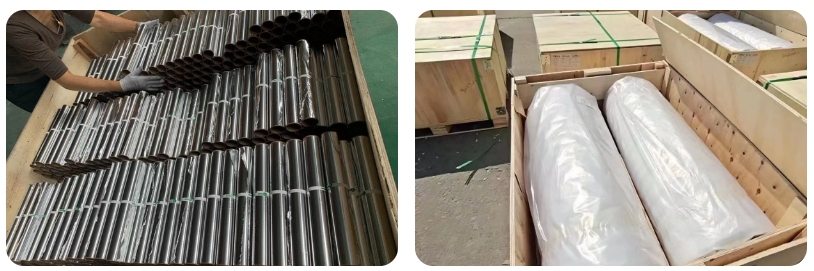
Foil packaging should be selected according to roll dimensions, gauge, core configuration and transport route. Thin rolls require protection against moisture, edge damage, telescoping, compression and movement during handling.
Suitable export packing can include moisture-resistant wrapping, rigid edge protection, secure strapping, pallets or enclosed cases. Rolls should be immobilized so the foil edges and winding are not damaged during international transportation.


For an accurate quotation, please provide the end application, alloy and temper if specified, nominal foil thickness and tolerance, width and width tolerance, core ID, maximum roll OD or roll weight, surface condition, coating or lamination requirement, downstream converting process, mechanical or pinhole requirements, quantity, required technical documents, packing method and destination.
Get an Aluminum Foil Jumbo Roll Quote
Aluminum foil is thin flat-rolled aluminum supplied primarily in rolls for packaging, containers, household use, pharmaceutical packaging, HVAC and industrial converting.
A practical general definition places aluminum foil at up to approximately 0.20 mm thick. Specific standards may cover narrower thickness ranges depending on the application and material condition.
No. A 300 mm aluminum product is plate, not foil. Requirements above conventional foil thickness should be specified as strip, sheet or plate as appropriate.
8011 and 1235 are commonly used for soft household and packaging foil. Final alloy selection depends on gauge, strength, rewinding and destination-market requirements.
3003, 3004, 8006 and 8011 are among the common container-stock alloys. O, H22 and H24 conditions may be selected according to forming depth and required finished rigidity.
8011, 8021 and 8079 are commonly used in pharmaceutical packaging structures, but the correct alloy, temper, coating and foil construction depend on whether the application is blister lidding, cold forming, tropical packaging or another system.
O temper is fully annealed and softer, providing greater ductility. H18 is a hard strain-hardened condition with greater strength and lower forming allowance.
Very thin foil may be rolled in paired layers during the final pass, producing a bright side and a matte side. Two-side bright foil is produced in suitable gauges where both surfaces contact the rolls individually.
An intact continuous aluminum layer is an effective barrier, but a finished package also contains seams, seals, lids or laminates. Package airtightness and liquid resistance therefore depend on the complete construction.
No. Food-contact suitability depends on alloy, manufacturing cleanliness, surface treatment, coating, food type, temperature, contact duration and the regulatory requirements of the destination market.
Compatibility should be evaluated for the actual food and conditions of use. A suitable food-contact lacquer or other protective layer may be required for aggressive contents.
Bare aluminum itself is not the conventional heat-seal layer. Heat-seal applications normally require a compatible lacquer, adhesive or polymer layer matched to the mating substrate.
Pinhole control limits microscopic openings that can occur in very thin foil. It is particularly important for pharmaceutical, flexible packaging and other high-barrier applications.
Yes. Aluminum foil can be printed, coated and laminated when the surface cleanliness, wettability, primer, adhesive and curing system are compatible with the converting process.
Custom slitting can be discussed according to foil thickness, alloy and production capability. Provide width tolerance, core ID, roll weight, edge requirement and winding direction for precision converting.
EN 546, ASTM B479, GB/T 3198 or another mutually agreed specification can be used where applicable. The exact standard should match the alloy, temper, thickness and end application.
No. ASTM B479 specifically covers certain annealed aluminum and aluminum-alloy foils for flexible barrier, food-contact and general applications within its defined material and thickness scope. Other foil products may require different standards.
Not automatically. Battery current collectors require specialized alloy, conductivity, strength, thickness, surface and cleanliness requirements defined by the battery manufacturer.
Yes, dedicated fin stock can be supplied for suitable HVAC applications. Alloy, temper, gauge, hydrophilic or corrosion-resistant coating and fin-forming requirements should be specified separately.
Aluminum is recyclable. Practical recovery of used foil depends on contamination, coatings, laminates and the recycling infrastructure available in the destination market.
Foil rolls can be protected with moisture-resistant wrapping, edge protection, secure strapping and seaworthy pallets or cases according to roll size and transportation conditions.
Please provide application, alloy and temper if known, nominal gauge and tolerance, roll width, core ID, roll OD or weight, surface condition, coating or lamination requirements, converting process, quality requirements, quantity, required documentation, packing method and destination.
Products
Application
Quick links
Contact Us