3003 Anodized Mirror Aluminum Sheet
You are here: Home » Products » 3003 Anodized Mirror Aluminum Sheet

loading

Share to:
facebook sharing button
twitter sharing button
line sharing button
wechat sharing button
linkedin sharing button
pinterest sharing button
whatsapp sharing button
sharethis sharing button

3003 Anodized Mirror Aluminum Sheet

3003 anodized mirror aluminum sheet combines a bright reflective surface with a sealed oxide layer for decorative panels, signage, interiors and formed components requiring a durable metallic finish.
  • 3003 anodized aluminum sheet

  • DINGANG

  • 7606125000

Availability:
Quantity:

3003 Anodized Mirror Aluminum Sheet

3003 anodized mirror aluminum sheet combines an Al-Mn aluminum substrate with a bright reflective surface and an anodic oxide finish for decorative panels, interior architectural components, signage, appliance panels, furniture and other applications requiring a metallic mirror-like appearance.

The available thickness range is 0.17-1.0mm, with standard widths of 1000mm, 1200mm and 1250mm. Custom anodized colors can be discussed according to the required appearance, coloring method, sealing process and production feasibility.

The term mirror describes the bright visual finish of the sheet. Where total reflectance, specular reflectance, diffuse reflectance or optical performance is important, the required numerical value and test method should be specified separately rather than inferred from appearance alone.

Request 3003 Anodized Mirror Sheet Pricing

3003 Anodized Mirror Aluminum Sheet Sample

Technical Specifications

Parameter Specification
Product Anodized Mirror Aluminum Sheet
Alloy AA3003
Thickness 0.17-1.0mm
Width 1000mm / 1200mm / 1250mm
Surface Appearance Bright / mirror-like anodized reflective finish
Colors Custom anodized colors subject to coloring process, alloy response and approved appearance reference
Tensile Strength Reference 130 MPa listed as an original reference value; final mechanical properties must be confirmed according to ordered temper, thickness and applicable material standard
Yield Strength Reference 115 MPa listed as an original reference value; final mechanical properties must be confirmed according to ordered temper, thickness and applicable material standard
Reflective Performance Mirror-like appearance; numerical total, specular or diffuse reflectance should be specified and tested separately where required
Packing Export standard wooden pallets; customized packing can be discussed
MOQ 1 ton according to specification
Delivery Time Approximately 25 days after receipt of the agreed deposit or L/C, subject to final specification and production schedule
Payment Terms 30% T/T deposit with 70% balance against B/L copy, or 100% irrevocable L/C at sight according to agreed commercial terms
Typical Applications Decorative panels, ceilings, partitions, signage, appliance panels, furniture surfaces, elevator interiors and formed reflective decorative components

For quotation, provide thickness, width, required temper, mirror appearance, color, anodic coating requirement, sealing requirement, reflectance specification if applicable, fabrication process, quantity and delivery destination.

Send Your Mirror Aluminum Specification

What Is 3003 Anodized Mirror Aluminum?

Anodizing is an electrochemical process that converts the aluminum surface into an aluminum oxide layer that is integral with the underlying metal. The resulting surface can be used for decorative appearance and enhanced surface protection when the pretreatment, anodizing and sealing processes are properly controlled.

For a mirror-type finish, surface preparation before anodizing is particularly important. Mechanical polishing, chemical brightening or other controlled pretreatments can be used to develop the bright substrate appearance before the anodic layer is formed.

The anodic layer itself should not be assumed to create optical mirror performance automatically. Alloy composition, surface preparation, sheet quality, oxide-film construction and sealing all influence the final appearance.

3003 Alloy for Anodized Decorative Sheet

Al-Mn Alloy Construction

AA3003 is an aluminum-manganese alloy commonly selected where moderate strength, corrosion resistance and formability are required.

Mechanical Properties Depend on Temper

3003 mechanical properties vary substantially between O, H14, H24, H18 and other material conditions. Tensile and yield values should therefore be specified together with temper, thickness and the applicable material standard.

Forming Capability

Suitable 3003 material can be cut, bent, stamped or otherwise formed into decorative components. Forming after anodizing should be evaluated carefully because severe deformation can change the appearance or damage the anodic surface at tight bends.

Mirror Appearance vs. Measured Reflectance

Mirror finish, high gloss and high reflectance are related concepts but are not technically identical. A surface can appear mirror-like without meeting a particular optical reflectance requirement.

Total Reflectance

Total reflectance describes the overall proportion of incident light reflected from the surface. If this value is important, specify the wavelength range, test method and minimum acceptance value.

Specular Reflectance

Specular reflectance represents directional mirror-like reflection and is particularly relevant where visual image clarity or controlled optical reflection is required.

Diffuse Reflectance

Diffuse reflectance represents scattered light. A decorative mirror surface and a precision lighting reflector can therefore require very different acceptance criteria even if both appear bright.

When Optical Performance Is Required

For luminaires, optical reflectors, solar concentrators or other performance-critical reflective components, provide the required measured reflectance, diffuse-reflection limit and applicable test method before material selection.

Where the highest specular reflectivity is the primary design requirement, higher-purity bright-anodizing grades may need to be evaluated instead of selecting 3003 solely from the product name.

Anodizing Process for Mirror Aluminum Sheet

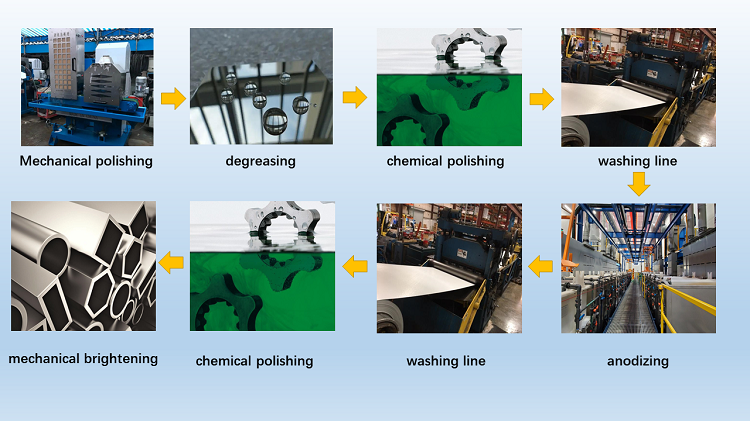
The exact production route depends on the target appearance and anodizing line. A typical decorative bright-anodizing route can include the following stages.

1. Surface Preparation

Mechanical polishing or other surface preparation can be used to create the required smoothness and brightness before anodizing.

2. Cleaning and Degreasing

Oil, processing residue and surface contamination are removed because surface cleanliness directly affects the consistency of the final anodized appearance.

3. Deoxidizing and Brightening

Chemical or electrochemical treatment may be used to remove the natural oxide and develop the required bright surface before anodizing.

4. Anodizing

The aluminum is electrochemically oxidized to form an integral porous anodic oxide layer. Coating thickness should be specified according to the intended decorative or protective requirement.

5. Coloring Where Required

The porous anodic layer can be colored using an appropriate anodizing-compatible coloring process when a colored mirror appearance is required.

6. Sealing

Sealing is performed after anodizing and coloring to reduce the porosity and absorption capacity of the anodic layer. Sealing quality is particularly important where appearance retention and environmental resistance are required.

7. Final Inspection and Surface Protection

Finished sheet should be inspected for brightness, color, surface uniformity and visible defects. Protective film can be applied where required to reduce handling damage during downstream fabrication and transportation.

Anodizing Process Flow for 3003 Mirror Aluminum Sheet

Anodic Coating and Sealing Requirements

Anodic Coating Thickness

Anodic coating thickness should be specified where corrosion resistance, appearance retention or project compliance is important. No universal oxide-film thickness should be assumed for every decorative or exterior application.

Sealing Quality

Proper sealing reduces the porosity of the anodic coating and can improve resistance to staining and environmental attack. Where sealing performance is contractual, specify the required test method and acceptance criteria.

Decorative and Architectural Standards

Where ISO 7599, AAMA 611 or another anodizing specification applies, identify the required finish class, anodic coating thickness, sealing requirements, color acceptance and test documentation before production.

Color Options for Anodized Mirror Sheet

Custom colors can be discussed according to anodizing and coloring capability. The phrase custom color should not be interpreted as meaning that every conventional paint color can be duplicated exactly by an anodized finish.

Color Appearance Depends on the Substrate

Anodized appearance can vary with alloy composition, temper, surface pretreatment, oxide thickness, coloring method and sealing conditions.

Use an Approved Appearance Reference

For projects requiring close visual matching, define an approved physical reference together with acceptable variation in brightness, tone and surface appearance.

Typical Applications

Architectural Decoration

3003 anodized mirror sheet can be used for compatible ceiling panels, partitions, interior decorative panels, trim and other architectural components where a bright metallic surface is required.

For exterior architectural use, anodic coating thickness, sealing, alloy appearance, fastening, environmental exposure and applicable architectural standards should be specified separately.

Elevator and Interior Panels

The bright anodized surface can be considered for decorative elevator interiors, wall panels and trim where the required sheet thickness and fabrication method are compatible.

Furniture and Display Components

Mirror-like anodized sheet can be used for suitable cabinet fronts, furniture trim, retail displays, decorative panels and exhibition components.

Home Appliance Decoration

The material can be evaluated for decorative appliance panels, trim and other visible components where the anodized surface and forming route meet the product requirements.

Signage and Nameplates

Bright anodized sheet can provide a durable metallic appearance for compatible signs, plaques, nameplates and branding components.

Decorative Automotive Components

Decorative trim components can be evaluated where the alloy, forming process, finish and vehicle-specific performance requirements are suitable. Safety-critical or optical automotive parts require separate engineering qualification.

Application Example of Mirror Reflective Anodized Aluminum

Fabrication Considerations

Cutting

Use appropriate cutting methods and clean handling practices to minimize scratches and edge damage on the visible mirror surface.

Bending

Tight bending after anodizing can produce visible changes or cracking in the anodic layer. Bend radius, temper, sheet thickness and anodic coating should be considered before fabrication.

Stamping and Forming

Where stamping or deeper forming is required, the process sequence should be reviewed. Forming before final anodizing can be preferable for some severe geometries, while pre-anodized sheet may be suitable for milder fabrication.

Protective Film

Protective film can help reduce handling scratches during cutting and fabrication. Film type should be compatible with the process, storage conditions and required peel characteristics.

Quality and Acceptance Requirements

Surface Appearance

Visible surfaces should be evaluated for unacceptable scratches, dents, stains, streaks, polishing marks, color variation and other defects according to the agreed inspection conditions.

Reflectance

Where reflectance is contractual, specify whether total or specular reflectance is required, together with wavelength range, instrument geometry, test method and minimum acceptance value.

Anodic Coating Thickness

Specify anodic coating thickness where required. Measurements should follow the agreed anodizing standard and applicable test method.

Sealing

Where sealing quality is important, specify the applicable sealing test and acceptance criteria rather than relying only on the description sealed anodized surface.

Mechanical Properties

If tensile strength, yield strength or elongation is contractual, provide the required AA3003 temper and applicable material specification so the mechanical acceptance range can be established correctly.

Ordering Information

1. Confirm Thickness and Width

Specify the required thickness from 0.17-1.0mm and the required 1000mm, 1200mm or 1250mm width.

2. Specify Temper

Where mechanical properties or forming performance are important, provide the required AA3003 temper rather than specifying alloy alone.

3. Define Mirror Appearance

State whether the requirement is primarily decorative brightness or a measured optical reflective property.

4. Define Reflectance When Required

For technical reflective applications, provide minimum total or specular reflectance and the applicable measurement method.

5. Specify Anodic Coating Requirements

Provide required anodic coating thickness, sealing requirement and applicable decorative or architectural anodizing standard where necessary.

6. Define Color

For colored anodized sheet, provide the required appearance reference and acceptable color variation.

7. Provide Fabrication Requirements

Identify cutting, bending, stamping or other downstream processes that may affect the mirror surface or anodic coating.

8. Provide Quantity and Destination

Provide order quantity, packing requirements and delivery destination. The listed MOQ is 1 ton according to specification.

Send Your Drawing & Surface Requirement

Frequently Asked Questions

What is 3003 anodized mirror aluminum sheet?

It is AA3003 aluminum sheet processed to achieve a bright mirror-like surface and then anodized to create an integral aluminum oxide layer for decorative and protective purposes.

Does anodizing itself make aluminum mirror reflective?

Not by itself. Mirror appearance depends strongly on the aluminum grade and surface preparation performed before anodizing.

What reflectivity does 3003 anodized mirror aluminum have?

No fixed reflectance should be assumed from the product name alone. If reflectance is important, specify the minimum required value and applicable test method with the order.

Is 3003 the best alloy for optical reflectors?

Not necessarily. 3003 can provide useful formability and corrosion resistance, but higher-purity aluminum grades are often selected when maximum specular reflectance is the primary requirement.

What thickness range is available?

The listed thickness range is 0.17-1.0mm.

What widths are available?

The listed standard widths are 1000mm, 1200mm and 1250mm.

Are 130 MPa tensile strength and 115 MPa yield strength guaranteed?

These are listed reference values, but AA3003 mechanical properties vary with temper and thickness. Contractual mechanical requirements should be confirmed against the ordered temper and applicable material standard.

Can custom anodized colors be produced?

Custom colors can be discussed according to the anodizing and coloring process. Final appearance should be agreed using an appropriate physical reference where color matching is important.

Is anodized aluminum scratch-proof?

No surface should be described as scratch-proof. Anodizing can increase surface hardness compared with bare aluminum, but abrasive contact can still damage the finish.

Is anodized aluminum completely corrosion-proof?

No. A properly specified and sealed anodic coating can improve corrosion resistance, but performance still depends on coating thickness, sealing quality, chemicals, moisture, salts and service environment.

How long does anodized mirror aluminum last?

There is no universal 10-year or 20-year service life for every anodized sheet. Durability depends on anodic coating specification, sealing, environment, maintenance, color system and application.

Can anodized colors fade?

Color stability depends on the coloring method, sealing quality and exposure conditions. Outdoor color-retention requirements should be specified for the actual anodizing system.

Can the sheet be bent after anodizing?

Moderate fabrication can be possible, but tight bends can affect the anodic surface. Bend radius, temper, thickness and finish should be evaluated before production.

Can it be used for exterior architectural decoration?

It can be evaluated for suitable exterior decorative applications when anodic coating thickness, sealing, alloy appearance and project requirements are properly specified.

What is the MOQ?

The listed minimum order quantity is 1 ton according to specification.

What is the typical delivery time?

The listed delivery period is approximately 25 days after receipt of the agreed deposit or L/C, subject to final specification and production schedule.

What information should I provide for a quotation?

Please provide thickness, width, temper, required mirror appearance, color, anodic coating requirement, sealing requirement, measured reflectance requirement if applicable, downstream fabrication process, quantity, packing requirement and destination.

Request a Quote for 3003 Anodized Mirror Aluminum Sheet

If you are sourcing 3003 anodized mirror aluminum sheet for decorative panels, signage, furniture, appliance components or architectural interiors, send us your dimensions, temper, surface appearance, anodizing requirements and order quantity for technical confirmation and quotation.

Contact Us for Pricing

Previous: 
Next: 

Product Category

Consult Us To Get Your Customized Aluminum Solution

We help you specify and source the coated aluminum you need, on time and within budget.

Products

Application

Quick links

Follow Us

Contact Us

    joey@cnchangsong.com
    +86-18602595888
   Building 2, Zhixing Business Plaza, No.25 North Street, Zhonglou District, Changzhou City, Jiangsu Province, China
    Chaoyang road, Konggang economic development area, Lianshui, Huai'an city, Jiangsu,China
© COPYRIGHT 2026 CHANGZHOU DINGANG METAL MATERIAL CO., LTD. ALL RIGHTS RESERVED.