1085 anodized aluminum sheet
DINGANG
7606125000
| Availability: | |
|---|---|
| Quantity: | |
1085 anodized mirror aluminum sheet is a high-purity reflective aluminum material for lighting reflectors, display components, decorative panels, appliances, signage and other applications requiring a bright metallic surface with an anodized finish.
The 1085 aluminum substrate is processed to produce a mirror-like surface and then anodized. During anodizing, the aluminum surface is electrochemically converted into an aluminum oxide layer that is integral with the base metal rather than applied as a separate paint film.
The current product range includes thicknesses from 0.17 to 1.00 mm and standard widths of 1000, 1200 and 1250 mm. Reflectance, temper, anodic film, surface appearance and forming requirements should be specified according to the final reflector or decorative component.
Request 1085 Mirror Aluminum Price
| Product | 1085 anodized mirror aluminum sheet |
| Alloy | AA1085 |
| Thickness | 0.17–1.00 mm |
| Standard Widths | 1000 mm, 1200 mm, 1250 mm |
| Surface | Mirror-finish aluminum with anodized surface treatment |
| Color | Natural reflective finish or customized anodized color subject to sample and process confirmation |
| Listed Tensile Strength Reference | 130 MPa; final mechanical properties should be confirmed according to the selected temper and purchase specification |
| Listed Yield Strength Reference | 115 MPa; final mechanical properties should be confirmed according to the selected temper and purchase specification |
| Temper | To be confirmed according to rigidity, flatness and forming requirements |
| Reflectance | Target value and measurement method should be specified for lighting or optical reflector applications |
| Anodic Film Requirement | To be confirmed according to surface durability, color and service environment |
| Protective Film | Can be specified where additional protection of the mirror surface is required during fabrication and transportation |
| Packing | Export-standard wooden pallets according to shipment requirements |
| Minimum Order Quantity | 1 metric ton according to specification |
| Payment Terms | 30% T/T deposit with 70% balance against the B/L copy, or 100% irrevocable L/C at sight according to the listed terms |
| Delivery Reference | Approximately 25 days after receipt of L/C or deposit, subject to final specification and production schedule |

AA1085 is a high-purity aluminum grade used where surface cleanliness and reflective appearance are important. A high-purity substrate provides a suitable starting material for controlled brightening, polishing and mirror-finishing processes.
For decorative and reflector applications, surface consistency is as important as nominal alloy. Polishing marks, haze, dents and local brightness differences can become highly visible on a mirror surface.
The listed thickness range from 0.17 to 1.00 mm allows the material to be evaluated for reflector blanks, light fittings, appliance trim, decorative inserts and other thin fabricated components.
Aluminum provides a reflective metal substrate at relatively low weight, which is useful for lighting fixtures, display systems and decorative panels where component weight is an important design consideration.
Anodizing is an electrochemical conversion process. During the process, aluminum at the surface is converted into aluminum oxide. The resulting anodic layer is therefore integrated with the underlying aluminum rather than being applied as a separate paint or metallic plating layer.
Before sealing, the anodic oxide has a porous structure that allows coloring or other controlled finishing processes. Sealing then stabilizes the surface and is an important part of the finished anodized system.
The final corrosion resistance, appearance and surface durability depend on alloy, surface preparation, anodizing conditions, film thickness, sealing quality and the service environment.
Discuss Your Anodizing Requirements
For lighting and optical components, a mirror-like visual appearance is not sufficient to define performance. Buyers should specify the required reflectance and measurement method before ordering.
| Optical Parameter | Purchasing Consideration |
| Total Reflectance | Defines the overall proportion of incident light reflected from the surface and is useful for general lighting-efficiency requirements |
| Specular Reflectance | Important where the component must direct light in a controlled mirror-like direction |
| Diffuse Reflectance | Relevant where reflected light needs to be distributed rather than concentrated in a single direction |
| Test Method | The supplier and buyer should use the same agreed measurement method when a guaranteed reflectance value is required |
| Production Sample | Recommended for confirming both visual mirror appearance and measured optical performance before bulk production |
Two aluminum sheets can both appear bright and mirror-like while producing different optical results. Surface roughness, polishing quality, alloy purity, anodizing and subsequent finishing can influence the way light is reflected.
Decorative customers may primarily evaluate visual brightness and surface uniformity, while lighting manufacturers normally require a measurable optical specification. These requirements should be separated in the purchase order.
Flatness affects both appearance and reflected-light direction. Edge wave, center buckle or localized distortion can produce visible optical distortion even when the mirror surface itself is bright.
Buyers using 1085 sheet for reflector panels, display backlighting or precision decorative surfaces should therefore define an acceptable flatness requirement together with thickness and width.
Fine scratches that may be difficult to notice on a matte sheet can become highly visible on a mirror finish. Cosmetic acceptance criteria should therefore be agreed for high-appearance applications.
Visible polishing lines can affect both decorative appearance and the reflected image. Buyers should state whether minor directional polishing marks are acceptable.
Localized haze or brightness variation can produce inconsistent appearance across adjacent reflector or decorative components. Production lots should be compared against an approved reference where consistency is critical.
Dents or pressure marks distort the reflected image and can affect reflector geometry. Packing, handling and fabrication surfaces should therefore be controlled carefully.
A suitable removable protective film can be specified where the mirror face needs additional protection during cutting, stamping, bending, transportation or installation.
Film adhesion should be selected according to the anodized surface, storage time and downstream process. Film should be removed according to the agreed handling procedure to reduce the risk of adhesive residue or difficult removal.
Request a Mirror Surface Sample
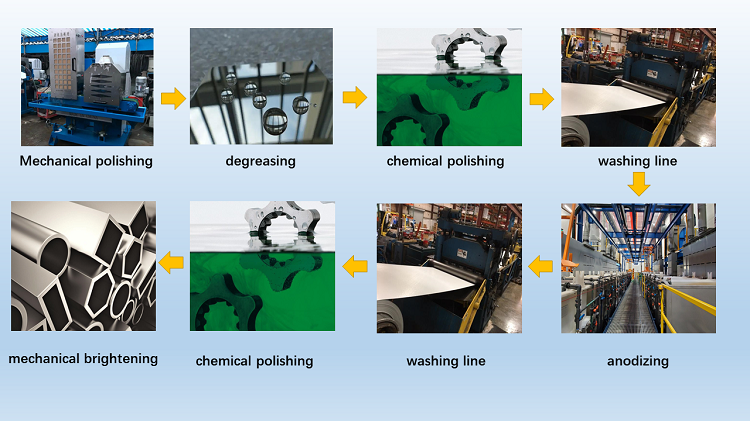
The existing production description for this material includes nine stages covering polishing, cleaning, anodizing and sealing. Actual process parameters are adjusted according to surface grade, alloy condition and anodizing requirements.

| Step | Existing Process Sequence |
| 1 | Mechanical polishing |
| 2 | Degreasing |
| 3 | Washing |
| 4 | Chemical polishing |
| 5 | Washing |
| 6 | Anodizing |
| 7 | Washing |
| 8 | Sealing |
| 9 | Mechanical brightening according to the existing process description |
The anodic oxide contains a porous structure before sealing. Sealing is therefore an important finishing step for stabilizing the anodized surface and achieving the specified corrosion and appearance performance.
Where colored anodized mirror aluminum is required, color and sealing conditions should be approved together because both affect the finished appearance.
Sheets can be cut or blanked into reflector components, decorative inserts and panels. Tooling and work surfaces should remain clean to prevent scratching the mirror face.
Shallow stamping and reflector forming can be evaluated when alloy temper, sheet thickness and anodized-surface requirements are compatible with the intended deformation.
Bend performance depends on temper, thickness, inside radius and anodic-film condition. Tight bends should be tested before mass production where surface cracking or loss of mirror appearance would be unacceptable.
Mounting holes and openings can be produced according to the finished component drawing. Burr and surface damage around processed edges should be controlled.
1085 mirror aluminum can be evaluated for LED luminaires, downlights, grille lamps, reflector panels and other lighting components. Lighting projects should define the required optical performance rather than relying only on visual brightness.
The material can be used for compatible display reflectors, illuminated advertising components and backlighting structures where a bright lightweight reflective surface is required.
Mirror aluminum can be used for ceilings, wall features, display areas, retail interiors and decorative panels where reflected light and a metallic mirror appearance form part of the design.
Suitable furniture applications include decorative cabinet fronts, furniture inserts, display panels and trim components where the selected sheet thickness and mounting method meet the design requirements.
1085 anodized mirror aluminum can be evaluated for appliance trim, reflective inserts, face panels and other compatible decorative components requiring a bright metal finish.
Reflective anodized aluminum can be used in premium signage, nameplates, display backgrounds and illuminated sign structures where mirror appearance is part of the visual design.
The material can be considered for selected non-safety-critical decorative trim. Regulated automotive mirrors, headlamp optical systems and safety-related vehicle components require separate engineering specifications and validation.

Discuss Your Reflector Application
Confirm alloy and temper against the approved purchase specification before releasing material for reflector or decorative-part production.
Check thickness and usable sheet width against the required part dimensions. The current listed widths are 1000, 1200 and 1250 mm.
For functional lighting or optical applications, measure reflectance using the agreed method and acceptance criterion rather than approving material solely by visual inspection.
Check for edge wave, center buckle, bow and localized distortion that could affect reflector geometry or mirror appearance.
Inspect for scratches, dents, haze, stains, polishing marks, brightness variation and other visible defects before processing.
Where anodic-film thickness, color or sealing performance is critical, state the required value and inspection method in the order specification.
For stamped reflector cups, bent panels or other formed components, produce a representative trial using the intended tooling before bulk production.
Specify whether the sheet is for a lighting reflector, display, decorative panel, furniture component, appliance part, signage or another application.
Provide the required temper if already specified. Otherwise, provide the part geometry and forming process so the required rigidity and formability can be reviewed.
Select thickness within the listed 0.17–1.00 mm range and specify 1000, 1200 or 1250 mm width together with finished dimensions and required tolerance.
For reflector applications, provide the required total, specular or diffuse reflectance and the required measurement method.
State natural or colored anodizing together with any required film thickness, sealing or corrosion-performance requirement.
For lighting reflectors and large decorative panels, include an acceptable flatness requirement to control optical distortion and panel appearance.
Define acceptable levels of scratches, polishing marks, dents, haze and brightness variation. An approved physical reference sample is recommended for high-appearance projects.
State whether the material will be cut, stamped, bent, punched, drilled or bonded so the material condition can be reviewed against the downstream process.
| Minimum Order Quantity | 1 metric ton according to specification |
| Payment Terms | 30% T/T deposit with 70% balance against the B/L copy, or 100% irrevocable L/C at sight according to the listed terms |
| Delivery Reference | Approximately 25 days after receipt of L/C or deposit, subject to material and production requirements |
| Packing | Export-standard wooden pallet packing with appropriate surface and edge protection |
| Recommended Inquiry Information | Application, temper, thickness, width and length, reflectance requirement, anodizing requirement, flatness, surface quality, fabrication process, quantity and destination |
Send Your 1085 Mirror Aluminum Specification
It is a high-purity AA1085 aluminum sheet with a reflective mirror-like surface and an anodized oxide layer. It can be used for lighting, display and decorative applications.
AA1085 is a high-purity aluminum grade that provides a suitable substrate for controlled mirror finishing where reflective appearance and surface cleanliness are important.
The current listed thickness range is 0.17–1.00 mm.
The current listed standard widths are 1000 mm, 1200 mm and 1250 mm.
The current specification for this page does not state one guaranteed reflectance value. For lighting and optical applications, provide the required reflectance and measurement method for order confirmation.
No. A visually bright mirror surface does not by itself define total, specular or diffuse reflectance. Functional reflector projects should use measurable optical requirements.
Yes, it can be evaluated for compatible LED reflector panels and lighting components. Reflectance, reflector geometry, forming and thermal conditions should be specified for the actual fixture.
Stamping can be evaluated for suitable geometries. Temper, sheet thickness, forming depth and anodized-surface condition should be confirmed before bulk production.
Yes, when temper, thickness, bend radius and anodic-film condition are compatible with the required geometry. Tight bends should be trialed before mass production.
Flatness affects both visual mirror quality and the direction of reflected light. Distortion, edge wave or center buckle can alter reflector performance.
Protective film is useful where the mirror surface must remain free from scratches during cutting, stamping, transportation or installation. Film compatibility should be confirmed with the finished anodized surface.
The anodic oxide is formed from the aluminum surface and is integral with the substrate rather than being applied as a separate paint film. Severe abrasion or mechanical damage can still damage the finished surface.
Anodizing improves corrosion resistance, but actual performance still depends on film quality, sealing, environment, edges, cleaning chemicals and exposure conditions.
Customized anodized colors can be discussed according to the required appearance and production process. A physical sample is recommended for color and mirror-effect approval.
The current product information lists a minimum order quantity of 1 metric ton according to specification.
The existing product information lists approximately 25 days after receipt of L/C or deposit. Actual lead time depends on material condition, anodizing, dimensions and quantity.
Please provide application, temper if known, thickness, width and length, reflectance requirement and test method, anodizing requirement, flatness, surface quality, fabrication process, protective-film requirement, quantity and destination.
Products
Application
Quick links
Contact Us