PPAL
DINGANG
7606125900
| Availability: | |
|---|---|
| Quantity: | |
Matte and glossy prepainted aluminum coil is designed for the manufacture of seamless rain gutters, downspouts, eavestroughs and related roof-drainage components where both forming performance and finished appearance are important.
The current product uses AA3003 aluminum with approximately 0.3–1.2mm thickness and master-coil widths from 800–1600mm. The coated surface can be produced in matte, low-gloss, satin, semi-gloss or glossy appearance according to the approved paint system and customer specification.
PE polyester and PVDF coating systems are available with RAL, PANTONE and custom color matching. Master coils can also be precision slit to match the exact feed width required by gutter and downspout roll-forming equipment.

| Parameter | Current Specification | Purchasing Notes |
| Product Type | Matte / Satin / Semi-Gloss / Glossy Prepainted Aluminum Coil | For gutter, downspout and exterior rainwater-system manufacturing |
| Alloy | AA3003 | Al-Mn alloy suitable for compatible roll-forming and bending processes |
| Temper | Project-specific | H14, H24 or another approved temper should be selected according to profile and forming requirements |
| Thickness | 0.3–1.2mm | Includes typical gutter and downspout gauge ranges |
| Master Coil Width | 800–1600mm | Current standard references include 1000mm, 1220mm and 1500mm |
| Slit Width | Customized | Specify the exact gutter or downspout machine feed width |
| Coating | PE Polyester / PVDF / Approved Project Coating | Select according to weathering, forming and appearance requirements |
| Primer | Current source reference 5–10μm | Final dry-film thickness should follow the approved coating system |
| Topcoat | Current source reference 15–25μm | Actual thickness depends on coating chemistry and finish |
| Total Front Coating | Current source reference 20–35μm | Confirm whether primer and topcoat are included in the contractual value |
| Reverse Side | Backing coat / primer / optional full color | Specify reverse coating separately where required |
| Surface Finish | Matte / Low Gloss / Satin / Semi-Gloss / Gloss / High Gloss | Nominal gloss value and tolerance should be agreed before production |
| Color | RAL / PANTONE / Custom Color | Physical color sample recommended for repeat or project orders |
| Mechanical Properties | Current broad tensile reference 120–180MPa | Actual values depend on temper and metal thickness |
| Elongation | Current source reference ≥15% | Confirm against the exact ordered temper and applicable substrate standard |
| Protective Film | Optional | Can protect high-gloss or appearance-critical surfaces during forming |
| Core ID | Customized | Specify according to the customer's uncoiler |
| Coil Weight | Customized | Match handling and production-line capacity |
| Reference Standards | ASTM B209 / EN 573 / EN 485 for applicable substrate requirements; EN 1396:2023 for applicable coil-coated aluminum requirements | Exact editions and test requirements should be stated in the order |
Gloss level has a direct influence on the appearance of gutters and downspouts after installation. It also affects how visible surface waviness, scratches, dirt and forming marks appear under daylight.
| Finish | Appearance | Typical Selection Considerations |
| Matte | Low reflection and subdued appearance | Can reduce visual emphasis on small surface irregularities and is suitable for modern architectural finishes |
| Low Gloss | Soft reflection with limited shine | Useful where a restrained appearance is required without a completely matte surface |
| Satin | Balanced soft sheen | Provides moderate reflection and is often suitable for residential exterior components |
| Semi-Gloss | Noticeable but controlled shine | Offers a traditional painted-metal appearance and can be easier to visually coordinate with fascia and siding |
| Gloss | Strong reflected light and smooth visual appearance | Highlights color depth but can make scratches and surface waviness more visible |
| High Gloss | Highly reflective decorative finish | Recommended where premium appearance is required and forming/handling controls are suitable |
Describing a finish only as “matte” or “glossy” can create differences between production batches because these words do not define an exact measurable value.
For repeat gutter production, the purchase specification should include a nominal gloss level, measurement angle and acceptable tolerance.
| 60° Gloss Reference | Finish Description |
| ≤10 GU | Matte |
| >10–20 GU | Low Gloss |
| >20–40 GU | Satin |
| >40–60 GU | Semi-Gloss |
| >60–80 GU | Gloss |
| >80 GU | High Gloss |
These ranges can be used as a practical reference for smooth coil-coated surfaces. Metallic, textured and embossed finishes may require different visual or instrumental acceptance methods.
Matte surfaces reflect less direct light and can provide a softer architectural appearance.
They can be useful where gutters need to coordinate with matte roofing, textured siding, dark fascia or contemporary façade finishes.
Semi-gloss provides a balance between surface shine and visual tolerance. It can offer enough reflection to create a clean painted appearance without the stronger mirror-like effect of high-gloss coatings.
Glossy surfaces can provide stronger color depth and a highly finished appearance.
Because reflected light can emphasize surface marks, high-gloss gutter coil benefits from good coil flatness, careful handling and controlled roll-forming tooling.
The same nominal color can look different when produced in different gloss levels.
For example, a dark grey in matte finish may appear visually different from the same pigment formulation in a high-gloss finish because reflected light changes the perceived shade.
For large residential developments, distributor programs and repeat orders, approving a physical coated sample is recommended before mass production.
Where color consistency is contract-critical, an agreed color tolerance can be specified in addition to the visual master sample.
Nominal gloss and allowable variation should be included in repeat-order specifications so different production batches maintain a consistent appearance.
AA3003 is an aluminum-manganese alloy that combines corrosion resistance with useful formability for compatible roof-drainage profiles.
The final mechanical properties depend strongly on the temper and metal thickness, so alloy designation alone should not be used as the complete forming specification.
H14 and H24 can be considered where the required gutter profile needs a balance between finished stiffness and roll-forming capability.
The preferred temper depends on profile geometry, hem design, bend radius, number of forming stations and required finished rigidity.
| Application | Common Market Reference | Approximate Metric Gauge |
| Seamless Gutter | .027 inch | Approximately 0.69mm |
| Heavy-Duty Gutter | .032 inch | Approximately 0.81mm |
| Standard Downspout | .019 inch | Approximately 0.48mm |
| Heavy Downspout / Elbow | .024 inch | Approximately 0.61mm |
These are market references only. The final gauge must be selected according to the finished profile, forming machine and customer specification.
The current 800–1600mm width range represents master-coil capability. Gutter and downspout manufacturers normally require narrower slit coils that feed directly into their roll-forming equipment.
Common North American 5-inch seamless gutter coils can use feed widths around 11.75–11.875 inches, depending on the specific machine and profile.
A common market reference for 6-inch seamless gutter coil is approximately 15 inches wide.
Rectangular and round downpipes require different flat-development widths, so buyers should provide the actual machine width or finished profile drawing.
| Comparison | PE Polyester | PVDF |
| Typical Use | General residential and commercial gutter systems | Premium or demanding exterior applications |
| Finish Options | Matte, satin, semi-gloss and glossy options | Matte, satin, gloss and selected specialty finishes |
| Forming | Good when the correct polyester grade is selected | Depends on the approved PVDF system and forming requirement |
| Weathering | Suitable for many normal exterior environments | Typically selected for stronger long-term UV and color-retention requirements |
| Cost Position | Generally more economical | Generally higher |
The aluminum substrate is cleaned and chemically pretreated before painting to support coating adhesion and corrosion resistance.
The current source lists approximately 5–10μm primer thickness. Final dry-film thickness should be confirmed against the actual PE or PVDF paint specification.
The current source lists approximately 15–25μm topcoat thickness. Final film build should be selected according to coating chemistry, gloss target and performance requirements.
The reverse side can receive a protective back coat, primer or full color coating according to the finished gutter or downpipe design.
Matte and glossy coils must both tolerate roll forming after coating.
Gutter production can create multiple bends, hems and ribs, making coating flexibility an important acceptance criterion.
T-bend testing can be specified to evaluate whether the coating remains attached and visually acceptable after severe bending.
The required value should be agreed according to the actual paint system and gutter profile.
For appearance-critical matte or glossy surfaces, a short production trial on the customer's actual roll-forming machine is recommended because tooling contact can affect surface appearance even when laboratory bend tests pass.
High-gloss surfaces can show scratches, roller marks, fingerprints and minor waviness more clearly than matte finishes.
Roll-forming tooling should be clean and properly aligned to reduce surface marking.
Temporary protective film can be considered where the visible surface requires additional protection during slitting, forming, transport or installation.
Edge wave, center buckle and poor winding can become visually noticeable on glossy finished components, making coil-shape control important.
Matte coatings reduce direct reflection but still require controlled handling to avoid scratches, polishing marks and contamination.
Repeated friction at forming rolls can locally change the appearance of some matte surfaces, so representative forming trials are recommended for new paint systems.
Pencil-hardness testing can be used as one reference for the cured surface condition of a gutter coating.
A defined solvent-rub test can be used to check whether a thermoset coil coating has reached the required cure condition.
Where contract-critical, the solvent, number of double rubs and acceptance criteria should be specified.
Impact testing can provide additional information about coating adhesion and flexibility under deformation.
The current source includes a five-year color-retention reference, but actual outdoor performance varies with coating chemistry, pigment, UV exposure, climate, orientation and maintenance.
A universal service-life guarantee should therefore not be based only on the words PE, PVDF, matte or glossy.
Gloss level can change during outdoor exposure, so long-term appearance should consider both color change and gloss retention.
Where required, an accelerated weathering specification should identify the test method, exposure cycle, duration and allowable color or gloss change.
The current source references a 1000-hour salt-spray target. This should only be used contractually when the test method and acceptance criteria are clearly defined.
Salt-spray exposure alone does not predict the exact outdoor service life of a gutter or downspout.
Coastal performance also depends on coating chemistry, salt deposition, cut edges, fasteners, adjacent metals, rainfall and cleaning.
Fasteners and connected metals should be selected to reduce galvanic corrosion under wet conditions.
Prepainted coil can be continuously roll formed into long gutter sections and cut according to the installation length.
Custom slit aluminum can be formed into rectangular or round rainwater downpipes using compatible forming equipment.
Matte, satin or glossy finishes can coordinate gutters with roofing, fascia, soffits, siding and window systems.
Custom colors and controlled gloss levels can be used for visible drainage systems on offices, hotels, retail buildings and other commercial projects.
Appearance-critical projects can specify color, gloss, coating thickness and physical approval samples before mass production.


EN 1396:2023 covers coil-coated wrought aluminum sheet and strip for general applications and includes requirements relating to coating thickness, gloss, color and surface appearance.
For matte and glossy gutter coil, the order should define the nominal surface finish, gloss measurement requirement, color standard and acceptable tolerances.
Textured, metallic, pearlescent and embossed coatings may require different visual acceptance criteria from smooth solid-color coatings.
AA3003 substrate chemistry, gauge and temper are controlled according to the approved material specification.
The aluminum strip is rolled and thermally processed to achieve the required thickness and forming characteristics.
The aluminum surface is cleaned and pretreated before coating to support adhesion and corrosion resistance.
A compatible primer is applied continuously before the decorative topcoat.
The selected PE, PVDF or approved paint system is applied under controlled roll-coating conditions to achieve the required color and gloss level.
The coating passes through a controlled oven process according to the paint-system curing requirements.
Master coil can be precision slit into machine-ready widths for gutter and downpipe production.
Finished material can be inspected for thickness, width, color, gloss, coating thickness, adhesion, forming behavior and coil shape before shipment.
| Inspection Item | Recommended Control |
| Alloy & Temper | Verify AA3003 and approved temper |
| Metal Thickness | Check nominal gauge and agreed tolerance |
| Slit Width | Measure against the gutter/downpipe machine feed requirement |
| Surface Finish | Confirm matte, satin, semi-gloss or glossy against approved reference |
| Gloss | Measure nominal gloss and acceptable tolerance using the agreed method |
| Color | Compare against approved RAL, PANTONE or physical master sample |
| Coating Thickness | Verify primer and topcoat against approved dry-film requirements |
| Back Coat | Verify reverse-side coating coverage and specification |
| T-Bend | Evaluate coating flexibility before high-volume roll forming |
| Adhesion | Use an agreed cross-cut, tape or equivalent method |
| Pencil Hardness | Specify where surface hardness is an acceptance requirement |
| Solvent Rub | Specify where coating cure requires verification |
| Surface Appearance | Check for scratches, dents, streaks, coating defects and unacceptable gloss variation |
| Coil Shape | Inspect edge wave, telescoping, loose winding and edge alignment |
Samples should be approved before recurring production when a new matte, satin, semi-gloss or glossy finish is introduced.
The sample should be evaluated under representative lighting conditions because perceived gloss and color can change with viewing angle and light source.
A short roll-forming trial is also recommended to check whether tooling changes the appearance of the painted surface.
Once approved, the color reference, gloss target, coating system, gauge, temper and slit width can be retained as the repeat-order standard.
| Purchasing Item | Information to Provide |
| Finished Product | Rain gutter / eavestrough / rectangular downpipe / round downpipe / accessory |
| Alloy | AA3003 |
| Temper | Provide H14 / H24 or another approved temper |
| Thickness | Provide metric or imperial gauge |
| Slit Width | Provide exact forming-machine feed width |
| Coating | PE polyester / PVDF / approved project system |
| Finish | Matte / low gloss / satin / semi-gloss / gloss / high gloss |
| Gloss Target | Provide nominal gloss units where appearance is critical |
| Gloss Tolerance | Provide acceptable batch and within-coil variation |
| Color | RAL / PANTONE / physical color sample |
| Color Tolerance | Specify if repeat batch matching is required |
| Primer | Provide required dry-film thickness where applicable |
| Topcoat | Provide required coating thickness |
| Back Coat | Specify backing paint or primer |
| T-Bend | Provide required forming-performance criterion |
| Adhesion | Provide test method where contract-critical |
| Protective Film | Specify if required, particularly for glossy finishes |
| Core ID | Provide uncoiler requirement |
| Coil Weight | Provide target or maximum weight |
| Winding Direction | Specify painted-side orientation where required |
Send Your Finish Specification
Matte and glossy painted coil should be protected against moisture, scratching, rubbing and edge damage during storage and transportation.
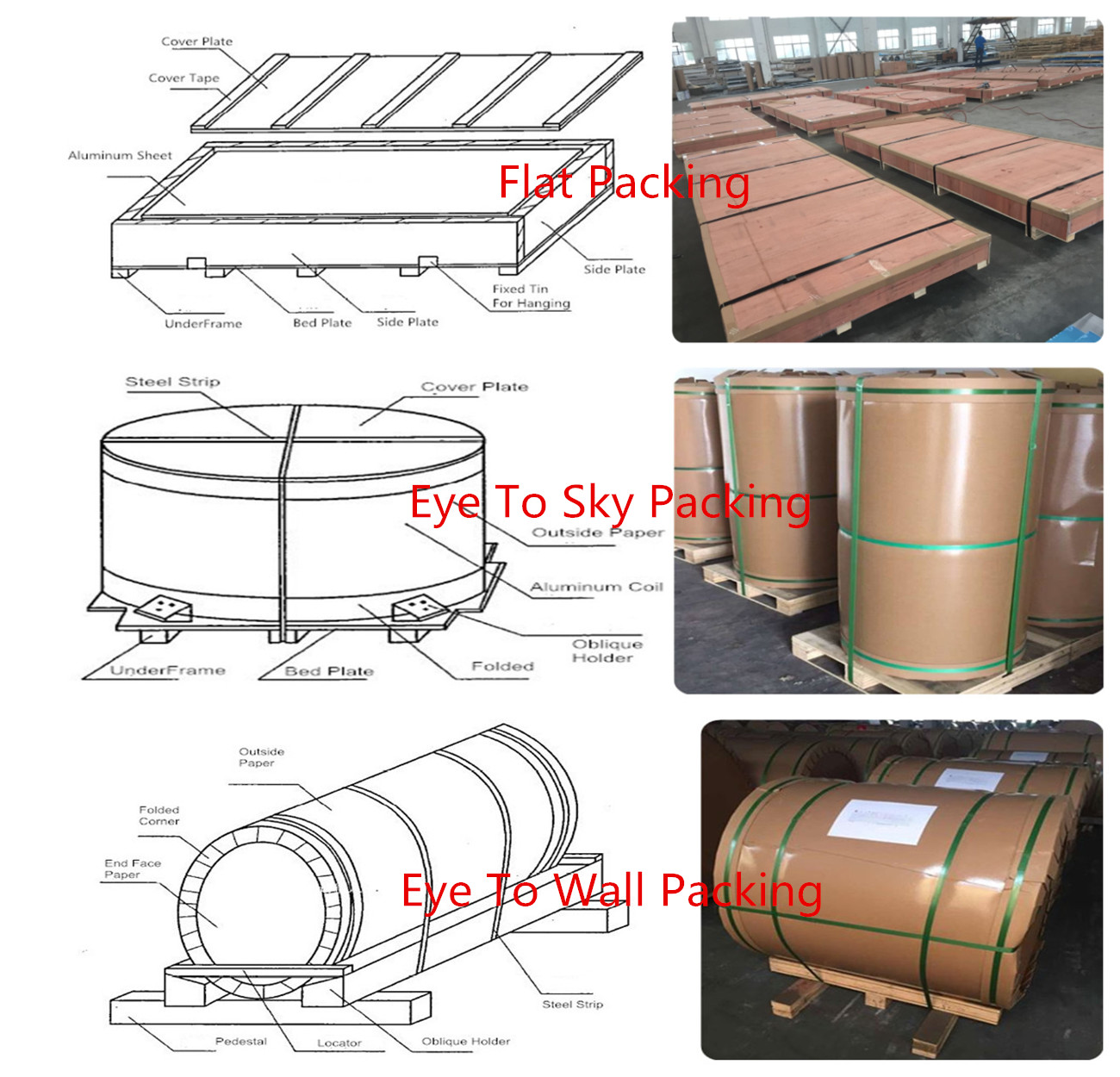
Export packing can include moisture-resistant wrapping, kraft paper, edge protection, strong strapping and wooden pallets in horizontal or vertical configurations according to coil size and handling requirements.
High-gloss coil may require additional surface protection where cosmetic appearance is particularly important.

For an accurate quotation, please provide the finished gutter or downpipe profile, AA3003 temper, thickness, exact slit width, coating system, required finish and purchasing quantity.
Please also provide the RAL, PANTONE or physical color reference, nominal gloss requirement, back-coat requirement and any T-bend or coating-adhesion specification.
For machine-ready coil, provide core ID, maximum roll OD, coil weight and winding direction.
Request Technical Details & Pricing
It is color-coated aluminum coil with a low-gloss surface designed for forming into gutters, downpipes and related rainwater components.
It is prepainted aluminum with a higher-gloss finish that provides stronger surface reflection and a more polished decorative appearance.
The main difference is surface gloss and visual appearance. Matte finishes reflect less light, while glossy finishes provide stronger shine and can make color depth more noticeable.
Lower-gloss finishes generally make minor surface waviness and handling marks less visually prominent than very glossy finishes.
This depends on color, environment and coating formulation. Glossy surfaces can be easier to wipe in some applications but may show dust, fingerprints and scratches more clearly.
Smooth coil-coated surfaces are commonly evaluated using a gloss meter at a defined measurement angle such as 60 degrees.
A 60-degree gloss value of approximately 10 gloss units or below can be used as a matte reference for smooth coil-coated aluminum.
Approximately 40–60 gloss units at 60 degrees can be used as a semi-gloss reference for suitable smooth coatings.
Approximately 60–80 gloss units at 60 degrees can be used as a gloss reference, while values above 80 represent a high-gloss finish.
Yes. Custom gloss levels can be discussed according to paint-system capability, order quantity and approved sample requirements.
Yes, subject to paint availability. However, the same nominal color can appear visually different at different gloss levels, so separate sample approval is recommended.
The current product uses AA3003 aluminum alloy.
The current production range is approximately 0.3–1.2mm.
These gauges fall within the current thickness range and can be discussed according to the required temper, slit width and production quantity.
Yes. Precision slitting can be discussed according to the exact feed width required by the customer's gutter or downpipe machine.
Current options include PE polyester and PVDF, with other compatible project-specific coating systems subject to confirmation.
The coated coil is bent after painting, so T-bend testing helps evaluate whether the paint can tolerate gutter forming without unacceptable cracking or loss of adhesion.
Yes. Protective film can be discussed where additional surface protection is required, although film compatibility with the forming process must be confirmed.
Not necessarily. Exterior durability depends primarily on coating chemistry, pigment, pretreatment, film thickness, UV exposure and environment rather than gloss level alone.
The current product information includes a 1000-hour salt-spray reference. Contractual performance should define the exact test standard, specimen preparation and acceptance criteria.
Yes. Color and gloss sample approval is particularly recommended before large or repeat orders.
Yes. Forming trials are recommended for new gloss levels, coatings, gauges or profile designs before recurring commercial supply.
Please provide alloy, temper, thickness, exact slit width, coating type, color, matte or glossy finish, nominal gloss value, back-coat requirement, core ID, coil weight and quantity.
If you manufacture seamless gutters, downpipes, eavestroughs or other roof-drainage components, send us your machine feed width, gauge, color and surface-finish requirements.
We can discuss AA3003 aluminum in 0.3–1.2mm thickness, matte, satin, semi-gloss and glossy finishes, PE or PVDF coatings, custom RAL/PANTONE colors and machine-ready slit coils.
Dingang supplies prepainted aluminum coil for gutter and downpipe manufacturers with customized alloy, temper, gauge, slit width, coating, color and gloss requirements.
For matte or glossy samples, roll-forming trials, custom color matching or bulk purchasing, contact our sales team with your required finish and machine specifications.
Changzhou Dingang Metal Material Co., Ltd.
Robert Tang (Sales Director)
Products
Application
Quick links
Contact Us