PPAL
DINGANG
7606125900
| Availability: | |
|---|---|
| Quantity: | |
3105 H24 white prepainted aluminum coil is a machine-ready raw material for seamless rain gutter, downspout, fascia and related rainwater-component manufacturing. The AA3105 aluminum-manganese substrate combines useful formability, atmospheric corrosion resistance and low weight for continuous roll-forming applications.
For gutter manufacturers, the critical purchasing parameters are not only alloy and color but also base-metal gauge, H24 temper, finished slit width, coil ID, coil OD, roll weight, coating flexibility, slit-edge condition and compatibility with the actual gutter-forming machine.
The current product range includes 0.3–1.2mm base aluminum, 800–1600mm parent-coil widths, PE, SMP and PVDF coating systems, white and custom colors, and customized slitting for seamless gutter and downspout production.
Request 3105 H24 Gutter Coil Pricing

| Parameter | Current Supply Specification | Gutter Manufacturing Consideration |
|---|---|---|
| Alloy | AA3105 aluminum-manganese alloy | Specify applicable substrate material standard on the purchase order |
| Primary Temper | H24 | Primary focus for seamless gutter roll-forming applications |
| Other Temper Options | H26 / H28 or agreed alternative | Do not substitute without reviewing strength, springback and forming behavior |
| Base Metal Thickness | 0.3–1.2mm | Specify aluminum gauge before coating and required tolerance |
| Parent-Coil Width | 800–1600mm | Published standard references include 1000mm, 1220mm and 1500mm |
| Finished Slit Width | Custom according to gutter machine | Provide machine model, gutter size and required developed blank width |
| Published Coil Length | 20–50m or custom | Longer production coils can be discussed according to gauge, slit width and machine limits |
| Coating Systems | PE / SMP / PVDF / agreed composite coating | Select according to weathering, color retention, forming and cost target |
| Primer | 5–10μm current published range | Confirm dry-film thickness and coating specification |
| Topcoat | 15–25μm current published range | Final thickness depends on selected paint system |
| Published Total Coating Thickness | 20–35μm | Define included coating layers before contractual use |
| Color | White / RAL / Pantone / Approved customer sample | Specify exact white shade and gloss for replacement consistency |
| Surface Finish | Matte / Semi-gloss / Glossy | Approve physical sample where appearance is critical |
| Mechanical Properties | According to exact AA3105-H24 gauge and material specification | Specify tensile, yield and elongation rather than using H26/H28 data interchangeably |
| Salt-Spray Reference | ≥1000 hours current published reference | Specify test method, specimen preparation and acceptance criteria |
| Published Temperature Reference | -40°C to +80°C | Confirm actual coating and finished-component conditions |
| Base-Material Requirements | ASTM B209/B209M / EN 573-3 / GB/T 3880 where specified | State applicable standard and edition on purchase documentation |
AA3105-H24 provides a useful combination of strength, formability and atmospheric corrosion resistance for compatible rainwater products.
Seamless gutter machines progressively form flat aluminum strip through a series of rollers. Material gauge, temper and coating flexibility should remain consistent so the profile can be formed without unacceptable cracking, wrinkling or dimensional drift.
H24 is partially strain-hardened and partially annealed, providing greater strength than soft O temper while retaining forming capability for many rainware applications.
Aluminum provides substantially lower density than conventional steel rainware, supporting easier coil handling, transportation and installation.
The aluminum substrate provides good atmospheric corrosion resistance while the organic coating adds environmental protection and architectural color.
For seamless gutter manufacturing, the finished slit coil is normally more important than the width of the original parent coil.
The developed blank width should match the actual gutter-machine tooling. Buyers should provide the machine manufacturer, model, gutter size and specified coil width rather than relying on a generic standard width.
Consistent slit width supports stable tracking through the rollers and helps maintain repeatable gutter dimensions.
Edges should be controlled for unacceptable burrs, folds and damage that could interfere with roll forming or create cosmetic defects in the finished gutter.
| Coil Parameter | Why It Matters |
|---|---|
| Finished Slit Width | Must match the gutter-machine blank-width requirement |
| Base Gauge | Influences stiffness, bead forming, springback and finished gutter strength |
| Coil ID | Must match the machine decoiler or customer rewinding system |
| Maximum OD | Must fit the unwind equipment and handling clearance |
| Roll Weight | Must remain within decoiler, lifting and transport limits |
| Winding Quality | Stable winding reduces telescoping and unwind disturbances |
| Color Side Orientation | Must match the machine so the exposed coated face appears on the correct side of the gutter |
Different regional gutter markets use different aluminum gauges, so one thickness should not be presented as universal.
The appropriate gauge should be selected from the finished gutter size, profile geometry, hanger spacing, local climate, snow or ice loading, transport requirements and the limitations of the production machine.
The gutter machine should be set according to the aluminum substrate gauge. Primer and topcoat should be specified separately rather than included in the nominal metal gauge.
When switching to a different gauge, check roller clearances, bead tooling, cutter settings, springback and finished profile dimensions.
| Temper | General Behavior | Manufacturing Consideration |
|---|---|---|
| H24 | Balanced strength and remaining ductility | Primary focus for compatible seamless gutter roll forming |
| H26 | Higher strength and reduced ductility compared with H24 | Confirm bead and hem forming before substitution |
| H28 | Harder strain-hardened condition | Use only where the forming process and finished profile are compatible |
Mechanical values from H26 or H28 should not be used as the acceptance criteria for an H24 order unless the purchase specification explicitly permits the alternative temper.
| Coating | Typical Selection Focus | Gutter-Coil Consideration |
|---|---|---|
| PE Polyester | Cost-effective general exterior coating | Common option for residential and general commercial rainware |
| SMP | Improved exterior weathering compared with basic polyester formulations | Useful where stronger UV or appearance-retention requirements apply |
| PVDF | Premium exterior weathering and color retention | Suitable for demanding architectural or high-exposure projects where specified |
The current product information lists 5–10μm primer and 15–25μm topcoat. Exact coating build should be confirmed for the selected paint system.
Where the concealed gutter surface will be exposed to persistent condensation, roof runoff or contact with other materials, the backside coating should also be defined in the purchase specification.
For repeat gutter programs, “white” should be treated as a controlled architectural color rather than a generic description.
Different whites can have noticeably different warm, cool, blue or cream undertones. An approved RAL, Pantone or physical sample should be used for repeat production.
Matte, semi-gloss and glossy finishes are available. Buyers can define nominal gloss and allowable batch variation where replacement components must match previous production.
For gutter, downspout and fascia supplied as one coordinated system, color approval should cover all visible components.
The painted coil must tolerate multiple progressive forming stages during seamless gutter production.
The front bead can create localized deformation in both the aluminum and coating. A production trial should confirm acceptable coating appearance at this area.
Tight hems can generate high localized strain. The minimum bend radius should remain compatible with the selected H24 substrate and coating construction.
Springback depends on temper, metal gauge and tooling geometry. Consistent H24 properties help maintain repeatable profile dimensions but do not eliminate the need for correct machine setup.
Machine cutters and notch tools should be maintained to reduce burrs, edge deformation and visible coating damage.
Request a Gutter-Machine Trial Coil

Custom slit AA3105-H24 coil can be supplied for compatible seamless gutter machines producing K-style, half-round, box or other profiles.
Suitable gauges and slit widths can be processed into compatible round or rectangular downspouts. Downspout coil requirements should be confirmed separately where the machine, thickness or strip width differs from the gutter line.
Color-matched aluminum can also be used for compatible fascia, flashing and related rainware trim to maintain consistent architectural appearance.
The material can be used for compatible residential, retail, office, hospitality, warehouse and other building drainage products after system sizing and installation requirements are established.

The coil provides the material for manufacturing the gutter and downspout profiles, but it does not determine the drainage capacity of the completed system.
Finished drainage design should consider:
Roof catchment area
Local rainfall intensity
Gutter cross-sectional area
Gutter slope
Outlet quantity and position
Downspout dimensions
Overflow provisions
Hanger spacing
Thermal expansion
Applicable local building requirements
AA3105 provides good atmospheric corrosion resistance, while the coating system provides additional protection and color.
The current product information references at least 1000 hours of salt-spray exposure. For contractual qualification, the test method, specimen condition, scribe procedure and acceptable blistering or corrosion should be defined.
Accelerated salt-spray exposure cannot be converted directly into a guaranteed number of outdoor years because real gutters also experience UV radiation, rainfall, temperature cycling, roof runoff and local pollutants.
Where long-term appearance is critical, use a defined weathering test, approved color reference and measurable color/gloss acceptance criteria instead of a general anti-fading percentage.
For gutter systems used in coastal environments, coating selection should consider salt deposition, rain washing, cut edges and compatible fasteners.
Hangers, screws and other hardware should be selected with galvanic compatibility in mind where aluminum remains wet or exposed to salt.
Slit and cut edges expose the aluminum substrate differently from the intact coated surface. Clean cutting, drainage and compatible detailing are important in severe environments.
| Inspection Item | Recommended Control |
|---|---|
| Alloy | Verify AA3105 according to specified base-material requirement |
| Temper | Verify H24 rather than relying on values from another temper |
| Base Gauge | Required 0.3–1.2mm nominal thickness and tolerance |
| Mechanical Properties | Tensile strength, yield strength and elongation for the actual H24 gauge |
| Finished Slit Width | Machine-specific width and tolerance |
| Slit Edge | Burr, edge fold, damage and alignment inspection |
| Primer Thickness | Current 5–10μm published range or agreed coating specification |
| Topcoat Thickness | Current 15–25μm range or agreed coating specification |
| Color | Approved white or custom-color master sample |
| Gloss | Nominal value and accepted variation where specified |
| Coating Adhesion | Evaluate before and, where required, after representative forming |
| Machine Forming Trial | Check bead, hem, springback, tracking and finished profile dimensions |
| Corrosion Test | Specify test method, duration and acceptance criteria |
| Coil Quality | Check winding, telescoping, coil ID, OD and roll weight |
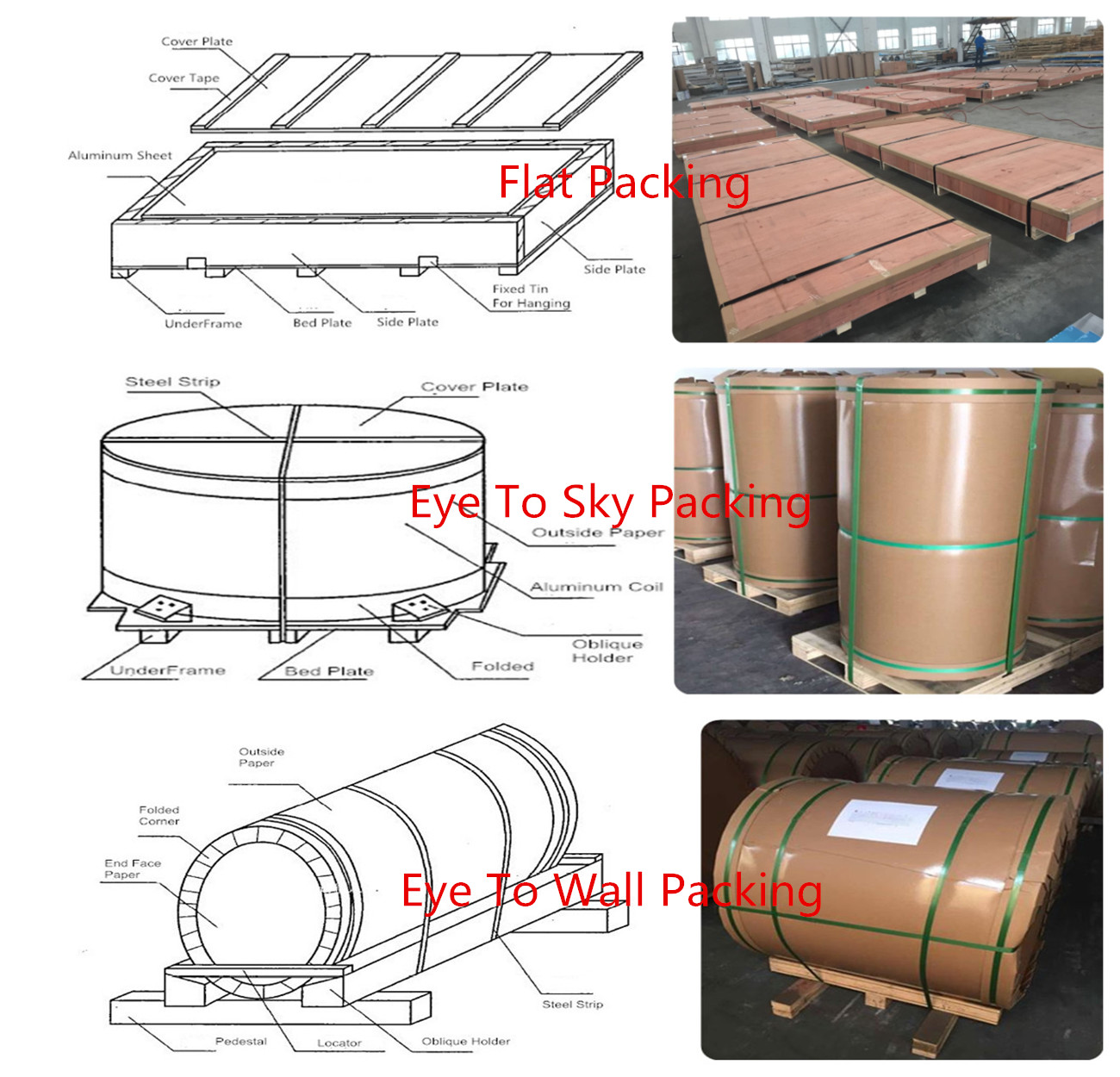
Export-standard seaworthy packaging is available in horizontal or vertical configurations according to customer handling requirements.
Coils can be protected using moisture-resistant wrapping, kraft paper, edge protection, secure banding and wooden pallets to reduce moisture, impact, surface scratching and coil deformation during long-distance transportation.

For an accurate machine-ready gutter coil quotation, please provide:
Gutter or downspout application
Gutter profile: K-style, half-round, box or custom
Finished gutter size
Gutter-machine manufacturer and model
Required finished slit width
AA3105-H24 requirement
Base-metal thickness
Thickness tolerance
Required tensile, yield and elongation values, if specified
Parent-coil width, if purchasing unslit coil
Coil ID
Maximum coil OD
Preferred roll weight
Winding orientation
PE, SMP or PVDF coating
Primer thickness
Topcoat thickness
Back-coat requirement
White color reference or approved physical sample
Gloss requirement
Coating-adhesion requirement
Post-forming coating acceptance
Salt-spray or weathering test requirement
Coastal or industrial exposure details
Required material standard or inspection document
Order quantity
Destination country or delivery port
Send Your Gutter Machine & Coil Specification
AA3105-H24 provides a practical balance of strength, formability, corrosion resistance and coating compatibility for compatible continuous gutter-forming processes.
Parent-coil width is the width of the large master coil before slitting. Finished slit width is the narrower machine-ready strip required by the specific gutter profile and forming equipment.
Yes. Custom slit widths can be discussed according to the gutter-machine model, finished profile and required blank width.
The current published base-aluminum range is 0.3mm to 1.2mm.
Gauge requirements vary by regional market, machine, profile geometry and project specification. Provide your machine model and required finished gutter specification so the material can be matched to the actual production requirement.
Not automatically. Harder tempers can increase strength and springback while reducing remaining ductility. A production trial should confirm bead, hem and profile forming before substitution.
Mechanical acceptance should be based on the exact AA3105-H24 gauge and applicable material specification. Data published for H26 or H28 should not be used interchangeably with H24.
Polyester coating is commonly used for general rainware production. SMP or PVDF can be considered where higher exterior weathering or color-retention performance is required.
The current product information lists primer of 5–10μm, topcoat of 15–25μm and total coating thickness of 20–35μm. The exact film build should be confirmed for the selected paint system.
Yes. White and other custom architectural colors can be matched to RAL, Pantone or approved physical samples subject to production feasibility.
Two white coils with the same basic color can look different if gloss levels differ. Repeat rainware programs should therefore control both color and gloss.
Coating behavior depends on substrate temper, gauge, bend radius, paint formulation and tooling. Representative machine trials are recommended for new material specifications.
No. Salt-spray hours should not be converted directly into outdoor service years because actual exposure also includes sunlight, wet-dry cycles, temperature changes, roof runoff and local pollutants.
It can be evaluated for coastal gutter systems, but coating selection, salt accumulation, cut edges, fastener compatibility and maintenance should all be considered.
ASTM B209/B209M primarily covers aluminum and aluminum-alloy sheet, including coiled sheet. Organic coating requirements should be specified and tested separately.
ISO 9001 is a quality-management-system standard for an organization. It is different from a material specification or individual product test report.
Third-party inspection or laboratory testing can be discussed according to purchase and project requirements. The required inspection scope should be agreed before production.
The current published reference is approximately 7–10 working days for standard specifications and 12–15 working days for customized specifications. Final timing depends on quantity, coating, slitting and production schedule.
No. Drainage capacity is determined by the finished gutter profile, roof catchment area, rainfall intensity, slope, outlets, downspout size and installation design.
Sample availability can be confirmed according to gauge, slit width, temper, coating and color. A representative machine trial is recommended before changing an established production specification.
Please provide gutter profile, gutter-machine model, finished slit width, AA3105-H24 gauge, coating system, color and gloss, coil ID, maximum OD, roll weight, testing requirements, order quantity and destination.
Products
Application
Quick links
Contact Us