5052 anodized aluminum sheet
DINGANG
7606125000
| Availability: | |
|---|---|
| Quantity: | |
5052 anodized mirror aluminum sheet combines the mechanical advantages of an aluminum-magnesium alloy with a bright reflective surface and an anodized finish. It is suitable for decorative panels, appliance components, furniture, signage, architectural interiors and other fabricated parts where both appearance and material strength are important.
Unlike high-purity mirror alloys selected primarily for maximum optical reflectance, AA5052 is often chosen where the finished component also requires higher strength, good forming capability and corrosion resistance. The mirror appearance, anodizing specification and mechanical condition should therefore be selected together according to the final application.
The current product range includes thicknesses from 0.17 to 1.00 mm and standard widths of 1000, 1200 and 1250 mm. Custom anodized colors, temper, surface requirements, protective film and fabrication requirements can be discussed according to the finished component.
Request 5052 Mirror Aluminum Price
| Product | 5052 anodized mirror aluminum sheet |
| Alloy | AA5052 |
| Thickness | 0.17–1.00 mm |
| Standard Widths | 1000 mm, 1200 mm, 1250 mm |
| Surface Finish | Mirror-finish surface with anodized aluminum oxide layer |
| Color | Natural reflective finish or customized anodized colors subject to sample and process confirmation |
| Temper | To be selected according to required strength, rigidity, flatness and forming process |
| Existing Tensile Strength Reference | 130 MPa according to the existing product data; final mechanical properties must be confirmed for the specified temper |
| Existing Yield Strength Reference | 115 MPa according to the existing product data; final mechanical properties must be confirmed for the specified temper |
| Reflectance | Required value and measurement method should be stated where optical performance is important |
| Anodic Film | Film thickness and sealing requirement should be agreed according to the service environment and surface requirement |
| Protective Film | Available where additional protection of the reflective surface is required during fabrication, transport or installation |
| Typical Processing | Cutting, blanking, punching, drilling, bending, shallow forming and compatible fabrication |
| Packing | Export-standard wooden pallets according to shipment requirements |
| Minimum Order Quantity | 1 metric ton according to specification |
| Payment Terms | 30% T/T deposit with 70% balance against the B/L copy, or 100% irrevocable L/C at sight according to the listed terms |
| Delivery Reference | Approximately 25 days after receipt of L/C or deposit, subject to final specification and production schedule |

AA5052 is an aluminum-magnesium alloy commonly selected when a decorative aluminum component needs more mechanical strength than high-purity aluminum grades typically chosen mainly for optical reflectance.
Actual strength depends strongly on temper. Buyers should therefore specify or confirm the required temper instead of assuming one tensile or yield value applies to every 5052 sheet.
5052 provides useful resistance to corrosion in many atmospheric and humid environments. Anodizing adds a controlled aluminum oxide surface that can further improve surface durability when correctly specified and sealed.
Depending on temper and thickness, 5052 can be cut, punched, bent and formed into decorative components, housings, trims and panels. Bend radius and forming depth should be reviewed before bulk production.
A polished or brightened surface gives the sheet its mirror-like appearance, while anodizing provides the specified oxide finish. This combination is useful where appearance and substrate strength are both important.
Discuss Your 5052 Material Requirements
5052 and 1085 mirror aluminum are not direct substitutes in every project. Material selection should depend on whether mechanical performance or maximum optical performance has the higher priority.
| Selection Factor | AA5052 | AA1085 |
| Primary Material Character | Aluminum-magnesium alloy with higher mechanical strength | High-purity aluminum selected primarily for surface and optical performance |
| Strength | Generally preferred where greater component rigidity or mechanical strength is required | Generally lower strength than work-hardened 5052 conditions |
| Corrosion Resistance | Useful for decorative and fabricated components exposed to humidity or more demanding environments | Suitable for many indoor and controlled reflective applications when correctly finished |
| Reflective Positioning | Reflective and decorative surface combined with structural performance | Preferred starting point where higher optical reflectance is the main requirement |
| Typical Priority | Strength + corrosion resistance + formability + decorative reflection | Reflectance + surface purity + optical performance |
The term “mirror finish” describes appearance but does not by itself guarantee a particular optical reflectance. A visually bright 5052 sheet may not provide the same optical performance as a high-purity reflector-grade sheet.
For functional reflectors, optical equipment or lighting components, the buyer should define the required total, specular or diffuse reflectance together with the applicable measurement method.
| Optical Requirement | What to Specify |
| Total Reflectance | Required minimum value and agreed test method |
| Specular Reflectance | Required where directional mirror-like reflection is important |
| Diffuse Reflectance | Required where light distribution rather than direct mirror reflection matters |
| Mirror Appearance | Approved visual reference sample for decorative applications |
| Test Sample | Recommended before bulk production for functional reflector applications |
Anodizing is an electrochemical conversion process. The surface of the aluminum is converted into an aluminum oxide layer that is integral with the underlying metal rather than being applied as a separate paint or plating layer.
Before sealing, the anodic oxide contains a porous structure that can accept suitable coloring processes. Sealing then closes or stabilizes the pores and is an important step in achieving the required appearance and corrosion resistance.
The anodized surface should not be treated as indestructible. Surface life depends on film thickness, sealing quality, environment, cleaning chemicals, abrasion, forming and installation conditions.
The existing product data do not state a guaranteed anodic-film thickness. Buyers should therefore specify the required film thickness where wear resistance, corrosion resistance, coloring or environmental exposure is critical.
A thicker or harder anodic layer is not automatically better for every formed mirror component. The required surface durability must be balanced against bend radius, stamping depth and the risk of visible cracking or crazing during deformation.
Flatness affects both the visual mirror effect and the fit of decorative panels. Edge wave, center buckle or bow can create visible distortion when the sheet reflects surrounding objects and light.
Mirror surfaces make fine scratches much more visible than matte aluminum. Surface acceptance limits should therefore be agreed for high-appearance applications.
Directional polishing marks can affect both reflected image quality and decorative appearance. A physical approved sample is recommended where the mirror effect is critical.
Haze, inconsistent brightness or anodized color variation can become noticeable when several panels are installed next to each other. Production lots should be compared against an approved reference.
Dents and pressure marks can distort the reflected image. Careful stacking, packing, handling and clean fabrication surfaces are particularly important for mirror-finish products.

A removable protective film can be specified to reduce scratching during cutting, bending, punching, transportation and installation.
The film adhesive should be compatible with the anodized mirror surface and the expected storage period. Buyers should also state whether the material will pass through forming dies, rollers or other equipment while the film remains attached.
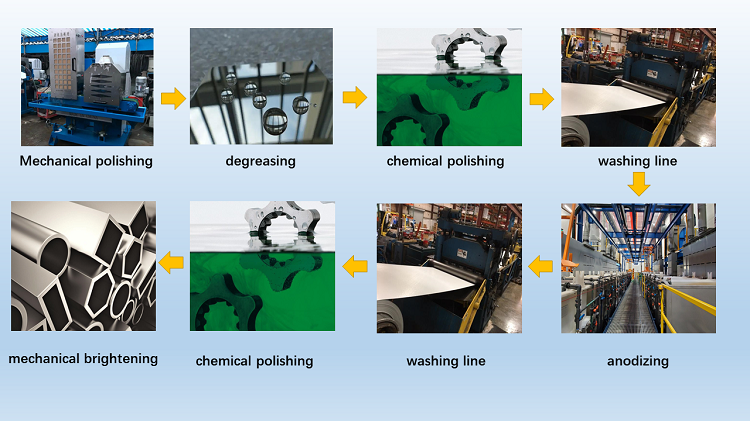
The existing process description includes nine stages covering polishing, cleaning, anodizing and sealing. Actual process parameters depend on the required mirror grade, anodic finish, color and final application.

| Step | Existing Process Sequence |
| 1 | Mechanical polishing |
| 2 | Degreasing |
| 3 | Washing |
| 4 | Chemical polishing |
| 5 | Washing |
| 6 | Anodizing |
| 7 | Washing |
| 8 | Sealing |
| 9 | Mechanical brightening according to the existing process description |
5052 sheet can be cut into decorative panels, appliance components, signs, covers and trim blanks. Work surfaces and tooling should be kept clean to protect the mirror finish.
Holes, slots and decorative openings can be punched according to the selected temper and sheet thickness. Tool clearance should be appropriate to control burr and edge deformation.
Bending performance depends on temper, thickness, bend direction, inside radius and anodic-film condition. Tight bends should be trialed where cracking or whitening of the finished surface would be unacceptable.
Shallow forming can be evaluated for compatible decorative and functional parts. Severe drawing operations should be tested using the intended temper and tooling before material approval.
Where the anodized sheet is bonded to another panel or substrate, adhesive compatibility should be verified using the actual surface, adhesive and curing conditions.
Send Your Part Drawing for Review
5052 anodized mirror aluminum can be evaluated for decorative wall panels, ceilings, feature panels, lift interiors, retail fixtures and other interior applications where a reflective metal appearance and increased substrate strength are required.
The sheet can be used for compatible cabinet fronts, decorative furniture inserts, shelving components, display furniture and trim where the selected thickness and mounting method meet the design requirements.
5052 mirror-finish anodized aluminum can be considered for appliance trim, control-panel surrounds, decorative covers and other visible components requiring a metallic appearance and practical forming performance.
Reflective anodized 5052 can be used for premium signage, display backgrounds, nameplates and decorative sign components where a durable reflective surface is part of the design.
5052 can be evaluated for selected non-safety-critical vehicle trim, decorative strips, interior accents and appearance components. Regulated rear-view mirrors, structural parts and safety-critical optical components require separate approved specifications.
The material can be evaluated for reflective covers or reflector components where mechanical strength and corrosion resistance are important together with a bright surface. Applications requiring maximum optical efficiency should specify reflectance or consider a dedicated high-purity reflector grade.
Because 5052 is commonly selected for its corrosion resistance, anodized decorative sheet can be evaluated for compatible interior or protected components in humid environments. Suitability still depends on anodizing quality, sealing, joints, edges and actual exposure conditions.

Confirm AA5052 and the required temper before fabrication. Mechanical strength, bend performance and springback vary significantly with temper.
Check sheet thickness and usable width against the approved drawing. The current listed thickness range is 0.17–1.00 mm and standard widths are 1000, 1200 and 1250 mm.
Inspect for scratches, dents, haze, stains, polishing marks, brightness variation and other cosmetic defects before cutting or forming.
Check for edge wave, center buckle, bow and localized distortion, particularly when the finished component uses a large uninterrupted mirror surface.
Where functional optical performance is required, measure reflectance using the agreed test method rather than approving the sheet only by visual brightness.
Where anodic-film thickness, sealing quality or color is critical, include the required specification and acceptance method in the purchase order.
For a new stamped, bent or bonded component, produce a representative trial using the intended tooling and assembly process before approving bulk production.
State whether the material will be used for architectural decoration, appliance trim, furniture, signage, vehicle trim, a reflector or another fabricated component.
Specify the required temper if already known. If not, provide required strength, bend radius, forming depth and finished geometry so the appropriate condition can be reviewed.
Select thickness within the listed 0.17–1.00 mm range and specify the required 1000, 1200 or 1250 mm width together with dimensional tolerances.
For decorative applications, provide an approved visual reference. For reflector applications, define the required measured reflectance and test method.
State natural or colored anodizing together with any anodic-film thickness, sealing, corrosion or wear requirement.
For large decorative panels and reflective parts, define acceptable flatness to control visual distortion and assembly fit.
Specify acceptable limits for scratches, dents, polishing marks, haze and color variation. A physical master sample is recommended for high-appearance products.
State whether the sheet will be cut, punched, bent, stamped, drilled or bonded so the material condition and surface protection can be reviewed.
| Minimum Order Quantity | 1 metric ton according to specification |
| Payment Terms | 30% T/T deposit with 70% balance against the B/L copy, or 100% irrevocable L/C at sight according to the listed terms |
| Delivery Reference | Approximately 25 days after receipt of L/C or deposit, subject to temper, surface, dimensions and quantity |
| Packing | Export-standard wooden pallet packing with suitable surface and edge protection |
| Recommended Inquiry Information | Application, temper, thickness, width and length, mirror requirement, reflectance if applicable, anodizing, color, flatness, surface acceptance, fabrication process, quantity and destination |
Send Your 5052 Mirror Aluminum Specification
It is AA5052 aluminum with a bright mirror-like surface and an anodized oxide layer. It combines reflective decorative appearance with the strength, formability and corrosion resistance associated with 5052 alloy.
5052 is generally selected when mechanical strength, forming capability and corrosion resistance are important together with a mirror appearance. 1085 is usually a better starting point when high optical reflectance is the main priority.
The current listed thickness range is 0.17–1.00 mm.
The current listed standard widths are 1000 mm, 1200 mm and 1250 mm.
The existing page does not define one temper. Buyers should specify the required mechanical condition according to strength, bend radius and forming requirements.
No. Those values are retained from the existing product data as reference values. Actual mechanical properties vary with temper and should be confirmed in the final purchase specification.
The existing specification does not state one guaranteed reflectance value. If reflectance is a functional requirement, specify the required value and measurement method before ordering.
It can be evaluated where strength and corrosion resistance are required together with reflection. Applications where maximum optical efficiency is the primary objective should compare measured reflectance with dedicated high-purity reflector grades.
Yes, when the selected temper, thickness, bend radius and anodized-surface condition are compatible with the required geometry. Tight bends should be tested before bulk production.
Punching and suitable shallow forming can be evaluated. Tooling, temper, forming depth and surface protection should be reviewed for the finished part.
Customized anodized colors can be discussed according to the required finish and process. A physical sample should be approved because color and mirror appearance influence each other.
Aluminum does not form iron rust, but it can corrode under unsuitable conditions. 5052 has useful corrosion resistance, and anodizing can further protect the surface when the oxide layer and sealing are correctly specified.
There is no single service-life value that applies to every application. Durability depends on anodic-film thickness, sealing quality, environment, UV exposure, cleaning chemicals, abrasion and maintenance.
Protective film is recommended when the mirror face needs protection from scratches during fabrication, transportation or installation. Film compatibility should be confirmed with the anodized surface.
The current product information lists a minimum order quantity of 1 metric ton according to specification.
The current product information lists approximately 25 days after receipt of L/C or deposit. Actual lead time depends on temper, dimensions, surface finish, anodizing and order quantity.
Please provide application, temper if known, thickness, width and length, mirror-surface requirement, reflectance if applicable, anodizing requirement, color, flatness, surface acceptance, fabrication process, protective-film requirement, quantity and destination.
Products
Application
Quick links
Contact Us